
HappyHorse Sports Team Photo Animation Prompts
Animate a sports team photo with HappyHorse using consent, identity locks, synchronized micro-motion, uniform and logo preservation, stable rows, and privacy-aware sharing.
Quick answer
Get consent for every identifiable person and special guardian approval where minors appear. Map each person by row and position, then request only synchronized breathing, natural blinks, and perhaps a tiny fabric response with a locked camera. Preserve every face, body, pose, hand, uniform number, crest, medal, ball, row, background, and crop; reject any clip that swaps identities or alters team membership.
Who this guide is for
Sports clubs, school and community teams, alumni groups, event photographers, families, and social managers creating respectful short animations from authorized team portraits.
Recommended model
| Use case | Recommended model | Why |
|---|---|---|
| This workflow | HappyHorse image-to-video | A restrained portrait-animation workflow can add subtle shared life to a posed group while treating identity, lineup, uniforms, and setting as protected source facts. |
AIBase is an independent creative platform. Model names are shown only to identify supported underlying technologies and workflow choices.
Prompt template
Animate the uploaded authorized sports team photo as the exact first frame. Preserve every person's identity, apparent age, facial structure, skin texture, expression, gaze, hair, body proportions, pose, hands, fingers, row position, overlap, height relationship, uniform cut and color, number, crest, name zone, footwear, equipment, medals, coach position, background, signage, floor or field lines, crop, camera angle, lighting, shadows, and color. Motion: synchronized subtle breathing and one natural blink per person at staggered moments; optional tiny loose-fabric movement only. Camera locked, [3-5 seconds], stable loop ending. Do not speak, cheer, wave, jump, turn, swap faces, add or remove people, change lineup, beautify, change uniforms or numbers, animate logos or text, move equipment, alter the venue, add crowd, watermark, or music.
Step-by-step workflow
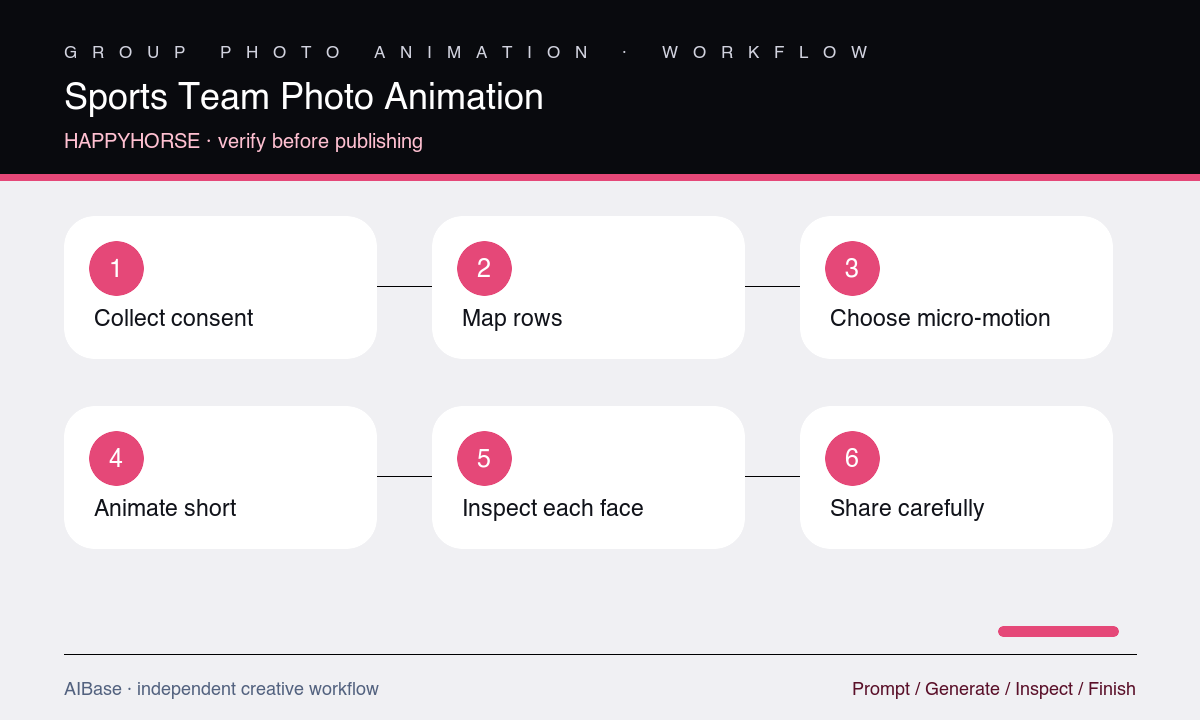
- Confirm photographer rights, consent for every identifiable person, guardian and organization approval where required, audience, retention period, and download or resharing policy.
- Create a row-and-position map, noting faces, hands, overlaps, uniforms, numbers, crests, medals, equipment, coaches, signage, venue lines, and source damage.
- Choose only subtle breathing, staggered blinks, and one low-amplitude fabric cue, keeping camera, bodies, equipment, rows, and background locked.
- Write identity and lineup invariants before motion, generate a three-to-five-second clip, and avoid global expressions such as everyone smile or cheer.
- Review frame by frame person by person for face swaps, eye and mouth drift, hands, numbers, crests, uniform seams, equipment, overlaps, row spacing, and background stability.
- Publish only to the consented audience, preserve the original, limit tagging and location data, and disclose AI motion when viewers could infer captured video.
Example prompt variants
- Four-second locked adult football team portrait with subtle breathing and staggered blinks only, preserve all eleven players and two coaches, exact row order, faces, hands, jersey numbers, crest zones, ball, goal, field lines, light, and crop.
- Three-second youth basketball team photo with guardian-approved use, one blink per person and tiny loose-jersey movement, preserve identities, apparent ages, seated and standing rows, uniform colors and numbers, ball count, gym markings, and no cheering.
- Five-second alumni rowing-team archive photo with gentle breathing only, preserve every identity, vintage texture, blazer crests, oars, row order, river background, monochrome tone, damage marks, and a stable loop.
Quality checklist
- Every person remains the same identity, age, expression, gaze, hair, body, pose, hand, row position, overlap, and height relationship throughout.
- Uniforms, colors, numbers, crests, names, medals, footwear, balls, rackets, oars, and repeated equipment counts remain source-accurate.
- Blinking and breathing are restrained and staggered, with no speaking, cheering, face swap, body shift, collision, row drift, or camera movement.
- Venue, signage, field or court lines, seats, background people, light, shadows, crop, archive texture, and source damage remain stable.
- Rights, adult or guardian consent, team approval, audience, tagging, location privacy, disclosure, and removal contact are documented.
Mistakes to avoid
- Using everyone cheer, wave, or jump, which forces overlapping bodies and faces to move beyond the evidence in a posed still.
- Reviewing the center players but missing face, number, hand, or uniform drift among smaller people at the edges and back row.
- Changing historic uniforms, crests, archive damage, venue signage, lineup, or equipment to make the image look cleaner or modern.
- Publishing youth or community team likenesses publicly without guardian consent, location review, download controls, and a removal path.
Related AIBase pages
- Open HappyHorse image-to-video
- Animate family photos
- Animate graduation photos
- Use the HappyHorse portrait guide
Practical next step
Open the most relevant AIBase generator, run one narrow prompt first, and save the best result before adding more constraints. The fastest way to improve output quality is to compare one variable at a time: subject, camera, background, lighting, then final polish.