
HappyHorse Vintage Postcard Photo Animation Prompts for Archive-Safe Motion
Add gentle depth, light, and texture motion to digitized postcards without rewriting handwriting, stamps, postmarks, or historical evidence.

Quick answer
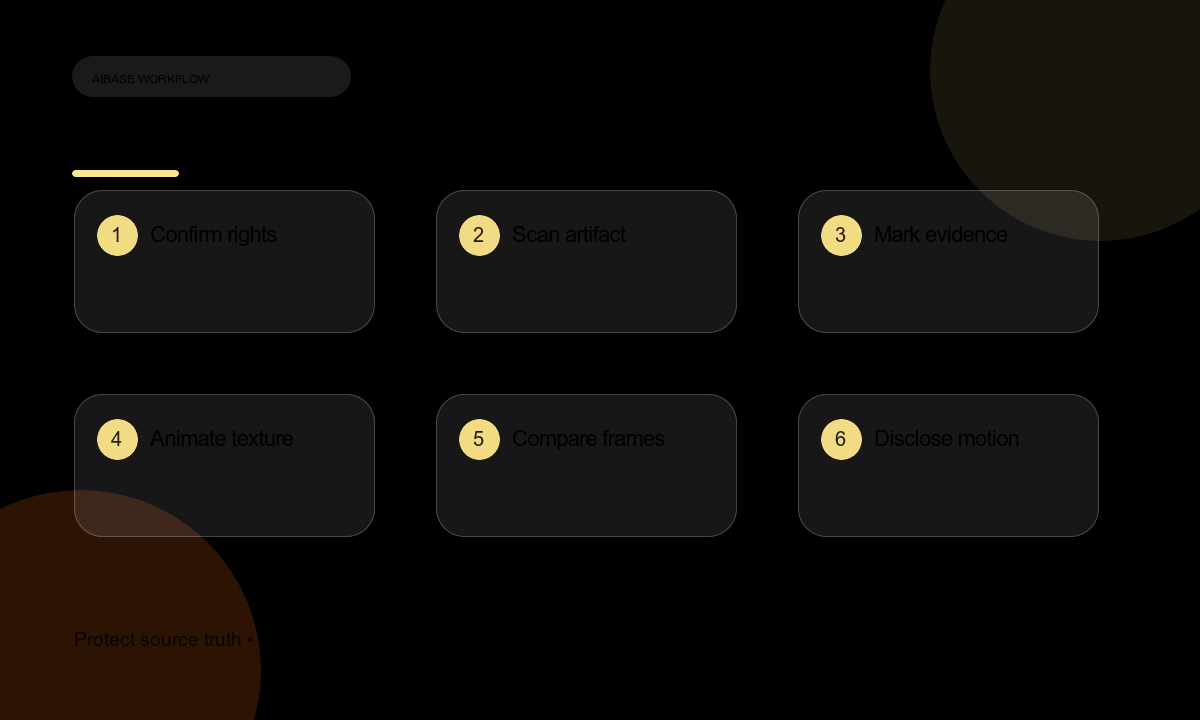
Treat the postcard as an artifact, not a scene to redesign. Confirm rights, scan the original, then use HappyHorse for subtle parallax, light, paper texture, or shadow motion. Keep handwriting, stamp, postmark, cancellation, tear, stain, and border detail unchanged, and disclose AI-assisted animation when the clip is used in historical interpretation.
Who this guide is for
Museums, local-history projects, genealogists, archives, educators, and collectors sharing documented postcards in exhibitions, lectures, or social media.
Recommended model
| Use case | Recommended model | Why |
|---|---|---|
| This workflow | HappyHorse 1.0 | It supports high-quality image-to-video motion, while archival integrity requires a protected scan and explicit evidence boundaries. |
AIBase is an independent creative platform. Model names are shown only to identify supported underlying technologies and workflow choices.
Prompt template
Use the uploaded authorized postcard scan as the exact artifact. Animate only [paper texture / soft light travel / shallow parallax / gentle shadow] for [4-6 seconds]. Preserve exact front and back composition, handwriting strokes, spelling, stamp, postmark, cancellation, address, border, embossing, stains, tears, creases, color shift, paper grain, and crop. Motion must not move or redraw any evidence. No rewritten text, cleaned ink, added person, building, watermark, sound narration, date interpretation, word, number, logo, or modern effect.
Step-by-step workflow
- Record provenance, date range, sender and recipient privacy concerns, collection rights, publication permission, and any restrictions.
- Scan or photograph both sides flat at high resolution without destructive correction or retouching.
- Mark every evidence element: handwriting, stamp, cancellation, address, printing method, damage, and archival marks.
- Choose one subtle motion and specify that it affects atmosphere only, not artifact geometry or ink.
- Generate a short test and compare frame-by-frame against the untouched scan at full resolution.
- Reject any stroke movement, text cleanup, morphing building, added color, removed stain, or shifted border.
- Publish with rights, caption, date uncertainty, collection credit, accessibility text, and AI-animation disclosure.
Example prompt variants
- Five-second front view: soft light crosses the existing paper grain while handwriting, stamp, border, and damage stay pixel-aligned.
- Four-second depth study: very shallow parallax between paper surface and scan background; no building or handwriting movement.
- Six-second back view: gentle shadow follows the existing fold without changing address, postmark, cancellation, or ink color.
Quality checklist
- Handwriting, spelling, stamp, cancellation, address, marks, damage, and printing detail remain unchanged.
- Motion is subtle and does not turn the postcard into a fabricated 3D scene.
- Provenance, rights, privacy review, collection credit, and restrictions are recorded.
- Date, location, and sender interpretations remain separate captions with appropriate uncertainty.
- AI-assisted animation is disclosed where viewers could mistake it for archival film.
Mistakes to avoid
- Correcting old handwriting or removing stains as if they were flaws.
- Animating buildings, vehicles, people, waves, or clouds into a static historical image.
- Presenting an inferred date, place, or sender as established fact.
- Skipping privacy review for names, addresses, and family correspondence.
Related AIBase pages
Practical next step
Open the most relevant AIBase generator, run one narrow prompt first, and save the best result before adding more constraints. The fastest way to improve output quality is to compare one variable at a time: subject, camera, background, lighting, then final polish.