
HappyHorse Dance Studio Portrait Animation Prompts with Consent Controls
Turn authorized dance portraits into subtle identity-safe animations while preserving costume, pose, studio context, and minor-consent rules.
Quick answer
Animate an authorized dance portrait with only a small smile, blink, breathing shift, or three-degree head turn. Lock face, body proportions, costume, hairstyle, pose, mirrors, studio equipment, and lighting. For minors, use documented guardian and dancer consent, avoid new body movement or costume exposure, and keep the destination private if required by the studio.
Who this guide is for
Dance studios, recital photographers, activity centers, and families creating short memory clips from already-approved portraits.
Recommended model
| Use case | Recommended model | Why |
|---|---|---|
| This workflow | HappyHorse for subtle portrait animation | It is designed around portrait-style motion, so a narrow micro-expression request can preserve identity better than a full performance simulation. |
AIBase is an independent creative platform. Model names are shown only to identify supported underlying technologies and workflow choices.
Prompt template
Animate the uploaded authorized dance portrait as the exact first frame. Over [3-4 seconds], allow only [one subtle blink / small natural smile / gentle breathing shift / head turn under three degrees]. Preserve exact face, age, body proportions, skin tone, hairstyle, hair accessories, makeup, costume, seams, embellishments, shoe ribbons, pose, hands, fingers, mirror reflections, studio equipment, floor marks, background people if authorized, camera, and light. No new choreography, dance move, body reshaping, costume change, exposed area, extra person, changed studio, text, sound, or watermark.
Step-by-step workflow
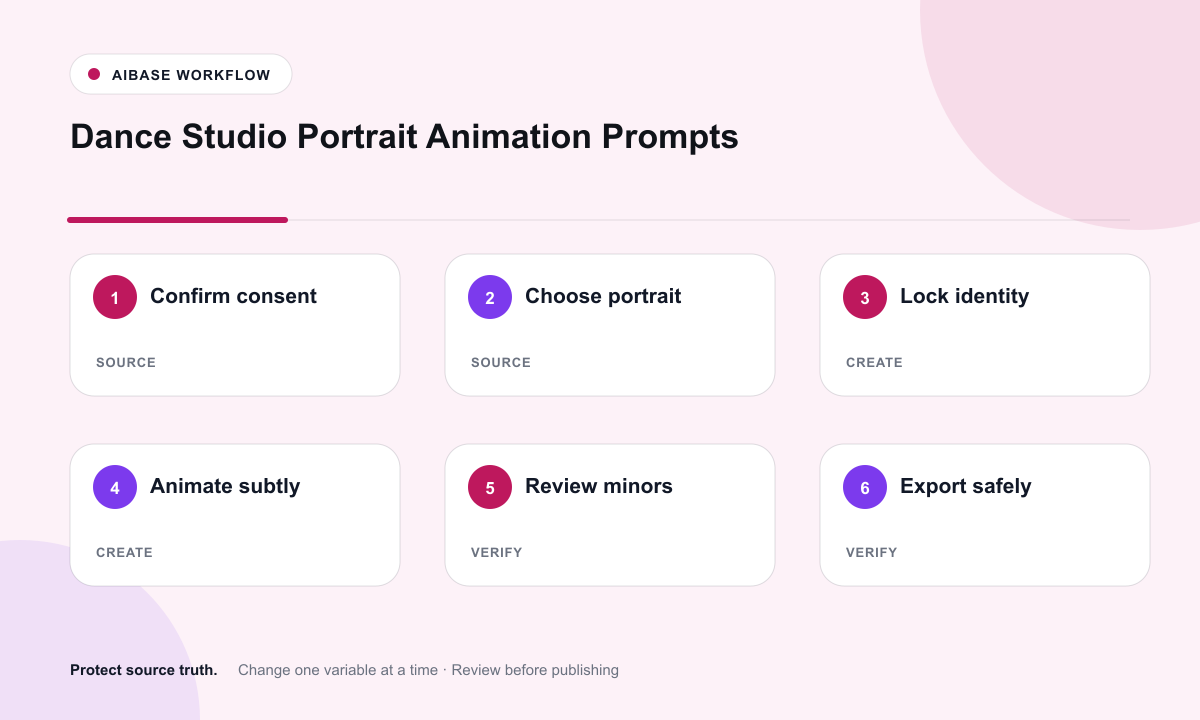
- Confirm photographer rights, dancer or guardian consent, studio policy, destination, retention limit, and platform age rules.
- Select a sharp, well-lit portrait with the full costume and a pose that can plausibly hold still.
- Request one micro-motion only and explicitly protect identity, costume, pose, hands, mirrors, and studio context.
- Review face stability, age appearance, fingers, costume details, background people, and any unintended movement.
- Export privacy-safe dimensions, avoid location metadata, add captions only with consent, and store according to policy.
- Recheck consent before reposting, advertising, public sharing, or using the clip beyond its original destination.
Example prompt variants
- Three-second recital portrait: one soft blink and gentle breathing shift while the tutu, pose, ribbon shape, and mirror remain unchanged.
- Four-character studio portrait: a small natural smile appears once; preserve costume lettering zone, hair accessory, hands, and studio background.
- Three-second adult company headshot in costume: tiny head turn toward camera while pose, garment, theater backdrop, and lighting stay stable.
Quality checklist
- Written subject, guardian when applicable, photographer, and studio permissions match the intended destination.
- Face, age, proportions, skin tone, hairstyle, costume, embellishments, and pose remain identical to the source.
- Animation adds only the requested micro-motion, with no new choreography, body change, or costume exposure.
- Minors, background people, location clues, captions, and metadata are handled according to consent and policy.
- Storage, retention, repost rights, review date, and deletion path are documented.
Mistakes to avoid
- Turning a portrait into new dance movement that never happened or could embarrass the subject.
- Animating a minor without documented guardian and studio consent.
- Leaving recognizable classmates, location signage, or metadata in a public clip.
- Changing costume, pose, body proportions, or age appearance while pursuing a “better” portrait.
Related AIBase pages
Practical next step
Open the most relevant AIBase generator, run one narrow prompt first, and save the best result before adding more constraints. The fastest way to improve output quality is to compare one variable at a time: subject, camera, background, lighting, then final polish.