
Veo 3.1 Pro Artisan Tea House Brand Film Prompts
Plan a controlled cinematic tea-house brand film with authorized space and maker references, one action per shot, and no invented origin claims.
Quick answer
Write a shot list where each generated shot has one subject, one action, one camera move, and a clear edit point. Use authorized references for the real tea room, maker, tools, and packaging; keep faces, hands, room geometry, and product details locked. Treat atmospheric shots as illustrative unless documented, and put origin, harvest, certification, caffeine, storage, and health information only in verified captions.
Who this guide is for
Tea houses, artisan food brands, hospitality studios, and agencies producing a short cinematic brand film for web, social, and in-store screens.
Recommended model
| Use case | Recommended model | Why |
|---|---|---|
| This workflow | Veo 3.1 Pro for longer cinematic shot concepts | It supports more controlled camera language and sustained atmosphere when each shot remains narrow and reference-led. |
AIBase is an independent creative platform. Model names are shown only to identify supported underlying technologies and workflow choices.
Prompt template
Create a [duration] cinematic text-free shot for an artisan tea-house brand film using the authorized [space / maker / tool / packaging] reference. Preserve exact identity, proportions, room geometry, fixtures, tools, garment, package, label zone, and source-supported activity. Action: [one specific movement]. Tea and water behavior: [physically plausible]. Camera: [one lens impression and one path]. Lighting: [one setup]. End on [stable edit point]. No changed face or hands, new room, invented farm or origin, harvest claim, certification, health benefit, caffeine claim, price, word, logo, cut, transition, sound, or watermark.
Step-by-step workflow
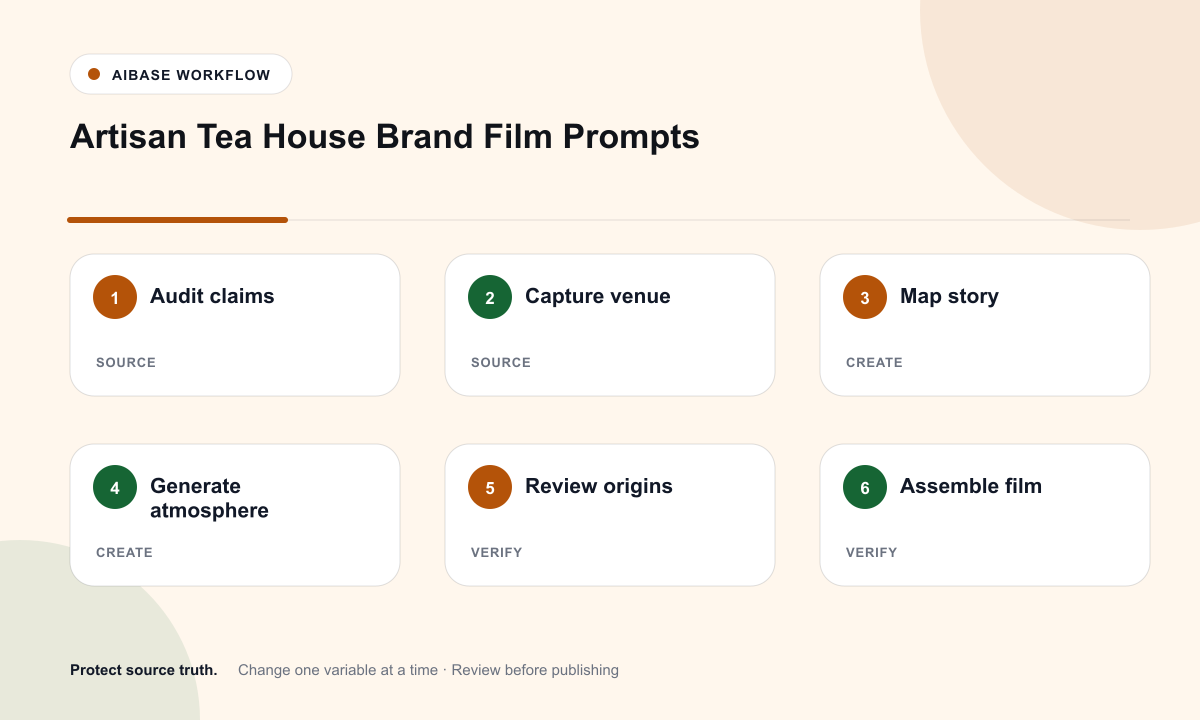
- Freeze brand truth: shop name, location, makers, sourcing language, certifications, brewing guidance, safety, and approved narrative.
- Collect authorized references for the room, tea maker, tools, water vessel, packaging, and real preparation stages.
- Storyboard no more than five to seven shots; assign each a single action, camera move, palette, and endpoint.
- Generate reference-led shots one at a time and reject any face drift, fused hand, impossible pour, or redesigned package.
- Composite real logo, origin text, captions, accessibility, music license, and disclosure in the edit.
- Test web, social, in-store screen, and muted playback; archive approvals and retire claims when sourcing changes.
Example prompt variants
- Authorized tea-room wide: slow dolly toward the real counter while steam rises gently from one existing teapot; preserve room geometry, fixtures, and light.
- Macro pour: existing water enters one teacup in a controlled arc; preserve cup glaze, liquor color, surface, hands, and camera; no health or origin claim.
- Maker detail: authorized hands slide one real tea caddy forward on the counter; preserve garment, fingers, caddy proportions, and label-free zone.
Quality checklist
- Each shot contains one subject, one action, one camera move, and a stable edit point.
- Authorized room, maker, tool, vessel, and packaging references retain identity, geometry, color, and scale.
- Water flow, leaf expansion, steam, and reflections remain physically plausible.
- Origin, harvest, certification, caffeine, storage, and health statements remain verified editable captions.
- Consent, music license, location permission, captions, screen tests, approvals, and expiry are documented.
Mistakes to avoid
- Generating a misty farm, mountain village, or harvest scene and implying it is the actual source.
- Requesting a personality-filled maker performance from a face or body without authorized reference.
- Turning every shot into a slow cinematic camera move until the film has no rhythm.
- Adding wellness, purity, origin, or certification language the tea business cannot substantiate.
Related AIBase pages
Practical next step
Open the most relevant AIBase generator, run one narrow prompt first, and save the best result before adding more constraints. The fastest way to improve output quality is to compare one variable at a time: subject, camera, background, lighting, then final polish.