
Veo 3.1 Pro Renewable Energy Brand Film Prompts Without Green Claims Drift
Develop cinematic clean-energy brand-film inserts while keeping real sites, technology, output, emissions, permits, communities, and sustainability claims verified.
Quick answer
Use verified real footage for the actual solar, wind, storage, grid, manufacturing, land, workforce, wildlife, and community context. Use Veo 3.1 Pro for generic non-evidentiary transitions such as light moving across neutral materials, abstract energy flow, or an unbranded empty lab concept. Cite boundaries, baselines, dates, sources, lifecycle scope, and uncertainty for every output, emissions, cost, recycling, local-benefit, or net-zero statement.
Who this guide is for
Renewable energy developers, climate-tech companies, utilities, researchers, infrastructure funds, and agencies producing premium brand films with careful evidence boundaries.
Recommended model
| Use case | Recommended model | Why |
|---|---|---|
| This workflow | Veo 3.1 Pro for generic cinematic connective footage | Longer visual continuity supports a polished narrative, but generated scenes cannot stand in for real projects, environmental performance, permitting, workforce, or community outcomes. |
AIBase is an independent creative platform. Model names are shown only to identify supported underlying technologies and workflow choices.
Prompt template
Create a [5-8]-second text-free cinematic connective shot for a renewable-energy brand film: [sunlight traveling across a neutral engineered surface / abstract current-like light moving through translucent layers / unbranded empty materials lab concept]. Camera: [slow dolly / locked macro], restrained motion, physically coherent light, stable endpoint, protected caption zone. No identifiable project, solar farm, wind farm, battery site, grid equipment, worker, community, landscape, wildlife, map, dashboard, output, emission reduction, cost, certification, permit, partner, logo, word, number, generated voice, or watermark.
Step-by-step workflow
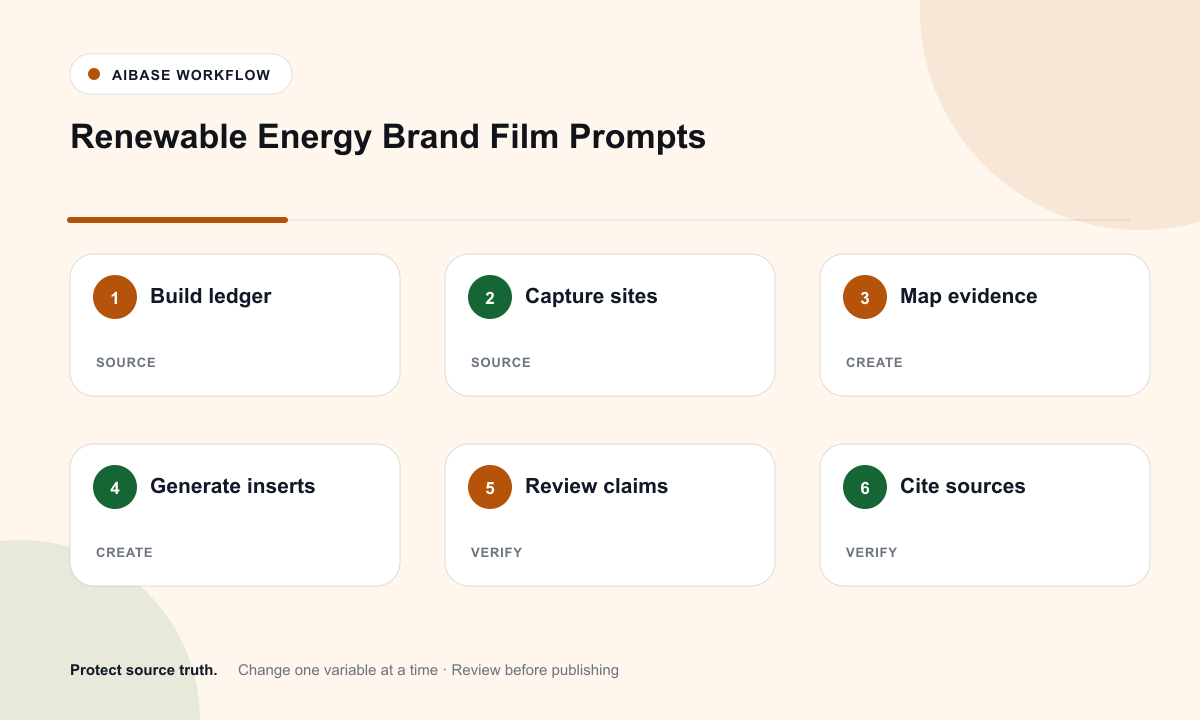
- Create a claim ledger covering technology, sites, ownership, capacity, generation, storage, grid services, lifecycle emissions, land, water, materials, recycling, permits, workforce, community, costs, and dates.
- Capture or license real project, equipment, manufacturing, testing, workforce, landscape, wildlife, and community footage with location and release records.
- Map the film into verified site evidence, sourced explanation, generic connective atmosphere, quantified claim cards, limitations, and a factual close.
- Generate one generic insert at a time with no identifiable facility, landscape, equipment, person, performance result, certification, or institutional endorsement.
- Review physics, implied technology, land and wildlife cues, worker safety, geographic inference, hidden logos, green imagery, and claim risk frame by frame.
- Assemble real footage, sourced metrics, baselines, dates, methodology, uncertainty, captions, licensed audio, disclosures, CTA, approvals, expiry, and correction route.
Example prompt variants
- Six-second macro of warm light traveling across an unbranded brushed composite surface, slow lateral dolly, no panel, turbine, battery, claim, text, or logo.
- Seven-second abstract energy-flow transition with one pale current moving through stable translucent layers, dark neutral field, no map, grid, dashboard, metric, or green leaf symbol.
- Five-second generic empty materials-lab concept with glass samples and soft daylight, locked camera and subtle focus shift, no identifiable technology, worker, certification, result, or text.
Quality checklist
- Projects, sites, technology, ownership, capacity, output, emissions, baselines, dates, costs, permits, workforce, community, and environmental facts are sourced.
- Generated footage is generic atmosphere and not evidence of a facility, technology, performance result, job, landscape, habitat, or public benefit.
- Every quantitative or comparative claim includes appropriate scope, baseline, date, source, methodology, qualification, and uncertainty.
- Worker safety, land, water, materials, recycling, wildlife, community consent, captions, audio, disclosure, and CTA are reviewed.
- Sources, releases, claim ledger, prompts, outputs, edit decisions, approvals, expiry, correction, and withdrawal remain traceable.
Mistakes to avoid
- Generating a beautiful solar or wind site and presenting it as an operating project.
- Using forests, children, wildlife, blue skies, or green fields to imply unmeasured environmental or community benefit.
- Claiming zero emissions, clean, recyclable, low cost, local jobs, or net zero without defined scope and evidence.
- Publishing timeless cinematic claims without dates, baselines, lifecycle boundaries, uncertainty, expiry, and a correction route.
Related AIBase pages
Practical next step
Open the most relevant AIBase generator, run one narrow prompt first, and save the best result before adding more constraints. The fastest way to improve output quality is to compare one variable at a time: subject, camera, background, lighting, then final polish.