
Nano Banana Pro Home Gym Equipment Campaign Photo Prompts
Build polished home gym campaign scenes around verified equipment geometry, safe setup, realistic rooms, inclusive users, and editable performance claims.
Quick answer
Start from approved product renders or photos whenever exact equipment identity matters. Use Nano Banana Pro to explore the room, light, user context, and campaign framing, while locking dimensions, joints, cables, plates, adjustment pins, handles, screens, feet, safety clearances, and included accessories. Depict one plausible low-risk activity, never infer medical, rehabilitation, weight-loss, strength, or performance results from generated bodies. Composite verified product pixels, instructions, warnings, specifications, prices, and claims from controlled sources before publication.
Who this guide is for
Fitness-equipment brands, retailers, home-gym designers, agencies, and ecommerce teams planning hero images, collection pages, paid social, seasonal campaigns, dealer kits, and showroom concepts for benches, racks, bikes, rowers, dumbbells, mats, or compact cable systems.
Recommended model
| Use case | Recommended model | Why |
|---|---|---|
| This workflow | Nano Banana Pro for high-fidelity room and campaign concepting with approved product references | Detailed material and environment control helps evaluate premium campaign directions, but generated equipment geometry and human form still require source-based compositing and specialist safety review. |
AIBase is an independent creative platform. Model names are shown only to identify supported underlying technologies and workflow choices.
Prompt template
Use the uploaded approved [equipment] images as exact product references. Preserve model, dimensions, frame geometry, welds, joints, cables, pulleys, handles, pins, plates, pedals, guards, console, upholstery, feet, finish, color, logo zone, included accessories, and required clearance. Place it in [truthful home space] on [appropriate surface]. Show [fictional adult/no person] performing [one low-risk neutral action] with plausible alignment and no implied result. Camera [angle], light [direction], copy-safe zone [region]. No redesign, missing safety part, impossible load, unstable floor, blocked exit, child, pet, injury, rehabilitation, body transformation, weight-loss cue, medical or performance claim, text, number, price, logo change, or watermark.
Step-by-step workflow
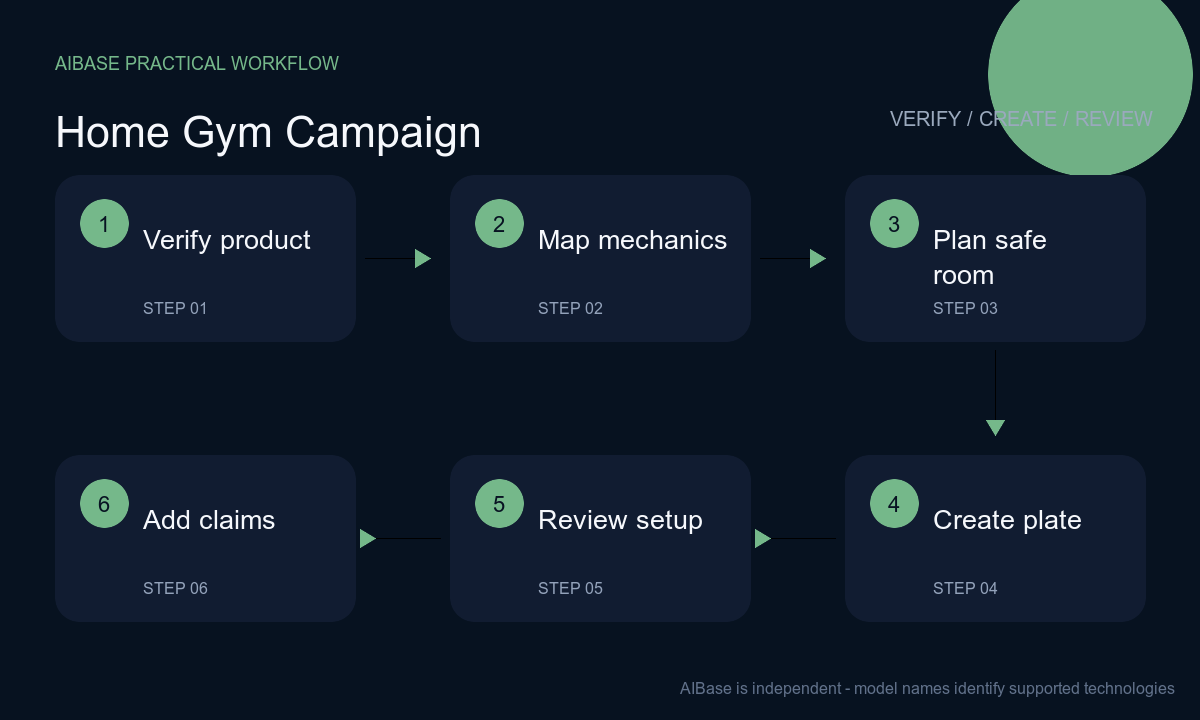
- Collect the current product model, dimensions, weight, setup diagram, clearances, included and optional accessories, load or usage limits, warnings, approved claims, finish samples, logos, and source assets. Assign engineering and legal reviewers.
- Create a geometry map naming every structural anchor visible from the planned angle. Mark components the model must not invent, omit, duplicate, bend, route through a body, or attach to the wrong joint.
- Choose a room that can physically hold the equipment with access, ventilation, ceiling height, door swing, floor protection, and circulation space. Decide whether a person adds useful scale or unnecessary anatomy and safety risk.
- Generate the environment and campaign direction in one camera setup. If product identity drifts, use the output as a background plate and composite the approved render instead of repeatedly prompting a fictional machine toward the SKU.
- Review equipment mechanics, cable routing, fasteners, floor contact, reflections, user anatomy, grip, posture, clothing, surrounding hazards, mirrors, electrical access, and visual implications with qualified owners before copy is added.
- Composite verified logo, feature names, dimensions, load information, assembly context, warnings, price, offer, financing terms, delivery, warranty, disclosure, and CTA as editable layers, then test every crop and destination.
Example prompt variants
- Wide campaign plate for an approved compact cable trainer in a real spare-room corner, preserve exact frame, dual pulley paths, handles, pins, base feet and matte graphite finish, one fictional adult standing beside it without exercising, morning side light, right copy zone, no invented attachment, claim, weight or text.
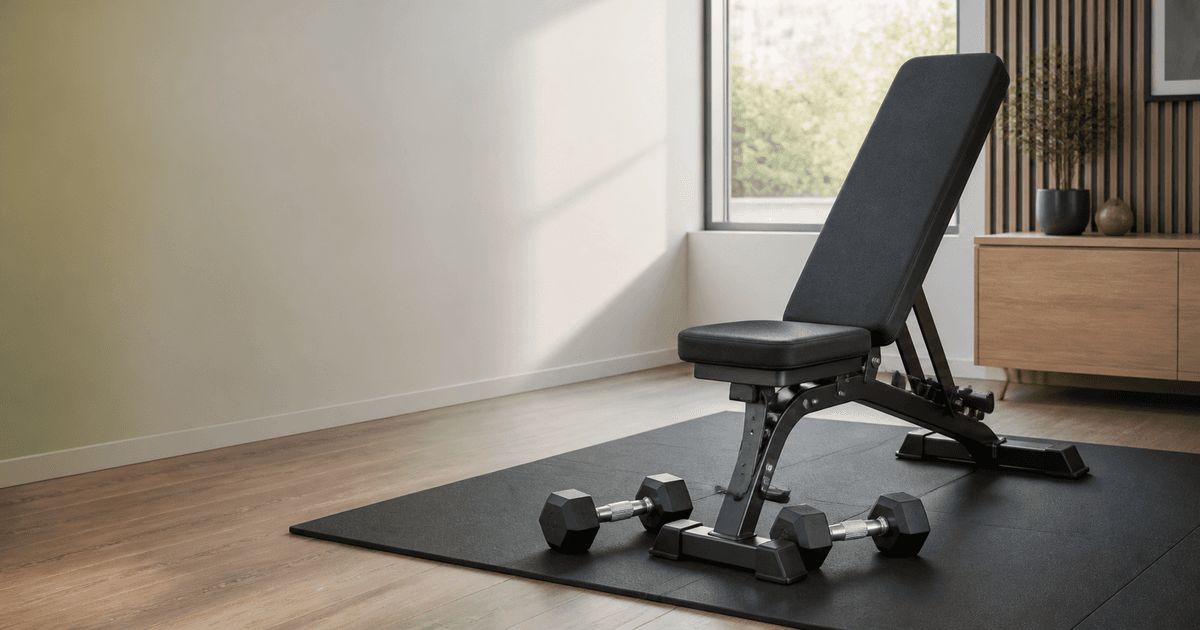
- Four-by-five product-led scene for an approved adjustable bench and dumbbell pair on a level rubber mat, preserve hinge, ladder positions, pad proportions, knurling, end caps and floor contact, no person, low window light and tidy apartment setting, no unstable load, mirror distortion, price, body or result cue.
- Square campaign concept for an approved indoor bike in a ventilated home office, preserve frame, flywheel enclosure, pedals, seat post, handlebar, console and clearance, fictional adult adjusting the seat while stationary, neutral posture, no riding stunt, sweat claim, calories, app screen, metric, logo or word.
Quality checklist
- Equipment model, dimensions, structure, attachment points, cables, pulleys, pins, guards, console, finish, accessories, clearances, surface, and installation match approved product truth.
- Any depicted person has plausible anatomy, grip, alignment, clothing, spacing, and low-risk interaction without unsafe loading, blocked mechanisms, falling objects, children, pets, or trip hazards.
- The scene does not imply weight loss, muscle gain, treatment, rehabilitation, pain relief, guaranteed performance, calorie output, certification, compatibility, or included accessories without evidence.
- Product, logo, specifications, warnings, price, offer, delivery, warranty, financing, disclosure, CTA, and destination remain source-controlled, readable, localized, and editable.
- References, room plan, prompt, generated plate, product composite, engineering review, claim approval, exports, channels, version, correction, and retirement remain traceable.
Mistakes to avoid
- Publishing a visually convincing fictional machine whose cable path, frame joint, guard, adjustment pin, screen, accessory, or footprint does not match the item customers buy.
- Using an athletic generated body as evidence of strength, weight loss, rehabilitation, health, calorie burn, or results attributable to the equipment.
- Placing a rack, bike, rower, or cable system in a room with impossible ceiling, door, wall, power, floor, mirror, ventilation, or safety clearance.
- Burning load limits, dimensions, prices, warranty, shipping, financing, app metrics, feature names, or safety copy into generated pixels that cannot be reliably checked or updated.
Related AIBase pages
Practical next step
Open the most relevant AIBase generator, run one narrow prompt first, and save the best result before adding more constraints. The fastest way to improve output quality is to compare one variable at a time: subject, camera, background, lighting, then final polish.