
Nano Banana Pro Stationery Campaign Product Photo Prompts
Build reference-led notebook, pen, planner, and desk-set campaign scenes while preserving page count, ruling, binding, hardware, paper color, scale, and package facts.
Quick answer
Start with front, back, spine, open-page, binding, nib or tip, closure, packaging, and scale references for the exact stationery SKU. Lock notebook dimensions, corner radius, cover material, page edges, binding count impression, ruling or grid, pen clip, trim, mechanism, colorway, and included pieces. Ask Nano Banana Pro to build one simple desk or flat-lay scene around those anchors. Composite exact cover artwork, page layouts, calendars, labels, barcodes, and claims from approved files rather than trusting generated writing.
Who this guide is for
Stationery brands, publishers, notebook makers, pen companies, marketplace sellers, subscription-box teams, photographers, and agencies planning ecommerce and seasonal campaign imagery.
Recommended model
| Use case | Recommended model | Why |
|---|---|---|
| This workflow | Nano Banana Pro image-to-image for high-fidelity stationery scene concepts | Multiple references can guide fine product construction and materials, but exact typography, page systems, dates, writing performance, quantity, and package claims still require approved source assets. |
AIBase is an independent creative platform. Model names are shown only to identify supported underlying technologies and workflow choices.
Prompt template
Use the uploaded authorized references as exact truth for [stationery SKU and colorway]. Create a [top-down flat lay / three-quarter desk scene / gift-set hero] in [ratio] with [surface], [lighting], and [copy-safe zone]. Preserve exact dimensions and scale, cover silhouette, corner radius, spine, binding type and count impression, page block thickness and color, visible ruling or grid spacing, elastic, ribbon, pocket, closure, pen barrel, clip, trim, nib or tip, mechanism, cap, package, included-piece count, colorway, material finish, contact, and shadow. Leave text-bearing zones unchanged or blank for compositing. No invented writing, calendar, page count, paper weight, ink behavior, refill, accessory, person, brand, claim, word, number, or watermark.
Step-by-step workflow
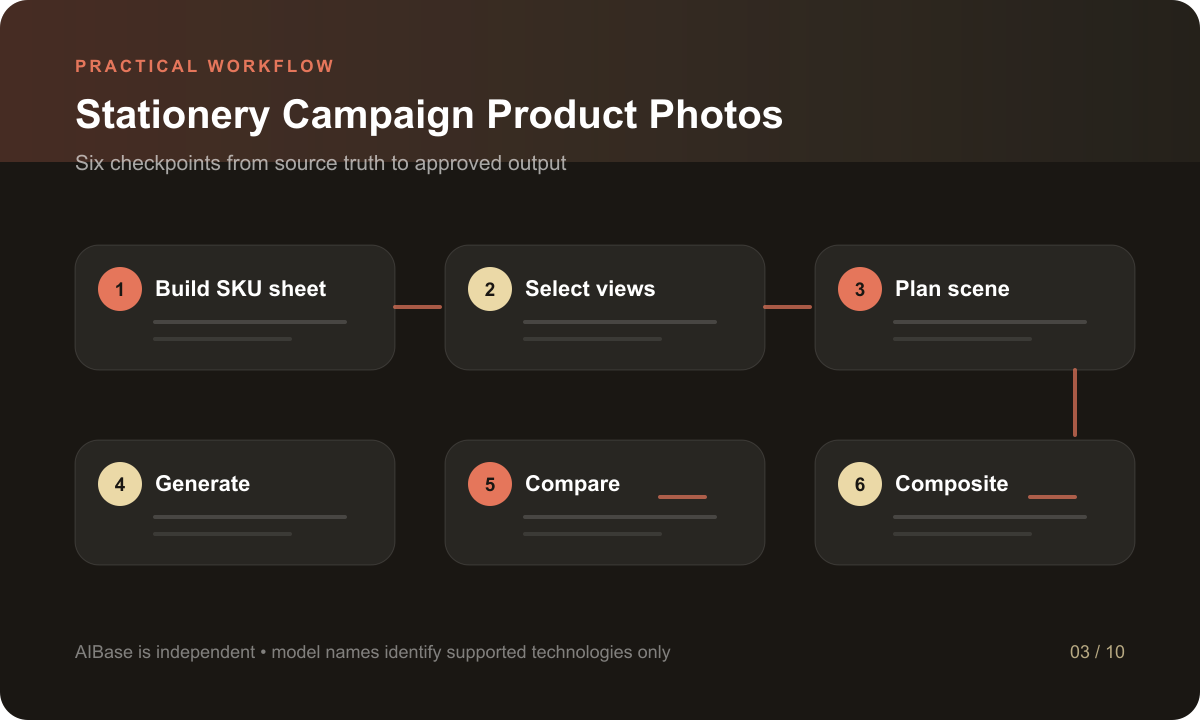
- Build an SKU truth sheet for dimensions, page count, paper weight and color, ruling, cover, binding, closures, pen mechanism, ink or refill, included pieces, packaging, claims, rights, and market.
- Collect authorized closed, open, side, spine, page, hardware, packaging, scale, and color-reference views; identify which artwork or text must be composited exactly.
- Choose one product arrangement and camera with physically plausible page overlap, pen contact, binding tension, shadows, and accessible copy space.
- Generate the environment and product concept in one ratio first, protecting all construction anchors and avoiding handwriting, dates, schedules, page claims, or extra accessories.
- Compare dimensions, page block, binding, ruling, corners, closures, pen parts, material, color, package, count, contact, and shadow against references at full size.
- Composite approved cover art, page layout, calendar, instructions, package copy, barcode, price, disclosure, and CTA; then export channel crops from the approved master.
Example prompt variants
- Top-down campaign flat lay with the authorized linen notebook, capped brass pen and matching paper band on warm oak, preserve notebook dimensions, rounded corners, spine, page block, elastic, pen clip and exact three-piece count, no writing or extra accessory.
- Three-quarter desk hero of the approved ring planner opened to a blank verified grid spread, preserve ring count, cover pockets, closure tab, page size, grid spacing and pale-cream paper, no date, handwriting, sticker or hand.
- Gift-set product scene using approved fountain pen, converter, case and two ink bottles in supplied positions, preserve nib shape, clip, cap bands, case insert and included count, no flowing ink, handwriting, refill claim or logo change.
Quality checklist
- SKU, dimensions, page count, paper, ruling, binding, closures, pen parts, refill, included pieces, packaging, colorway, materials, and claims match approved references.
- Notebook silhouette, page thickness, binding rhythm, corners, ruling, elastic, ribbon, pen geometry, hardware, scale, contact, and shadows remain coherent.
- No fictional writing, calendar, dates, page count, paper specification, ink performance, accessory, bundle, colorway, person, certification, or claim appears.
- Exact cover art, page templates, package copy, barcode, price, disclosure, and CTA are controlled editable layers.
- Truth sheet, references, prompt, outputs, comparison, composite, approval, crop set, and publication remain traceable.
Mistakes to avoid
- Allowing rings, coils, pages, pen clips, nibs, closures, ribbons, accessories, or bundle quantities to multiply or change.
- Generating handwriting, dates, planner layouts, paper specifications, ink samples, or packaging text and treating them as product truth.
- Using one front reference for an open-page scene and inventing the inside cover, binding, pocket, ruling, or page thickness.
- Adding an attractive desk object that looks included in the set or implies a lifestyle, certification, refill, or writing-performance claim.
Related AIBase pages
Practical next step
Open the most relevant AIBase generator, run one narrow prompt first, and save the best result before adding more constraints. The fastest way to improve output quality is to compare one variable at a time: subject, camera, background, lighting, then final polish.