
Veo 3.1 Pro Ocean Cleanup Brand Film Prompts With Evidence Boundaries
Plan cinematic ocean-cleanup films without fabricating locations, wildlife rescue, volunteers, waste volume, partnerships, impact metrics, permits, or documentary evidence.
Quick answer
Divide the film into documented evidence and clearly illustrative connective material. Use real approved footage for named places, people, vessels, collection methods, wildlife, partners, waste types, weights, dates, destinations and impact. Use Veo 3.1 Pro only for generic, non-documentary transitions such as abstract water-light textures, material-flow motifs or an unidentifiable empty coastline. Do not generate a rescue, cleanup event, before-and-after transformation, branded crew, recovered tonnage or healthy ecosystem and present it as something that happened.
Who this guide is for
Environmental organizations, responsible brands, foundations, research teams, agencies and filmmakers developing campaign concepts, fundraising explainers or educational brand films around marine debris and cleanup programs.
Recommended model
| Use case | Recommended model | Why |
|---|---|---|
| This workflow | Veo 3.1 Pro for polished illustrative connective shots around verified evidence | Cinematic control can support a coherent film language, but real people, places, operations, wildlife and impact claims require traceable source footage and expert review. |
AIBase is an independent creative platform. Model names are shown only to identify supported underlying technologies and workflow choices.
Prompt template
Create a [5-8 second] clearly illustrative brand-film plate for an ocean-cleanup story. Shot purpose [abstract transition / unidentifiable empty shoreline atmosphere / material-flow metaphor], environment [generic and non-locatable], camera [one restrained move], palette [specific], protected zones for disclosure and verified captions. No identifiable place, person, volunteer, vessel, equipment operation, branded uniform, wildlife interaction, animal rescue, active collection, waste count, before-and-after recovery, partner mark, impact result, word, number, logo, music or watermark. Do not present the scene as documentary evidence.
Step-by-step workflow
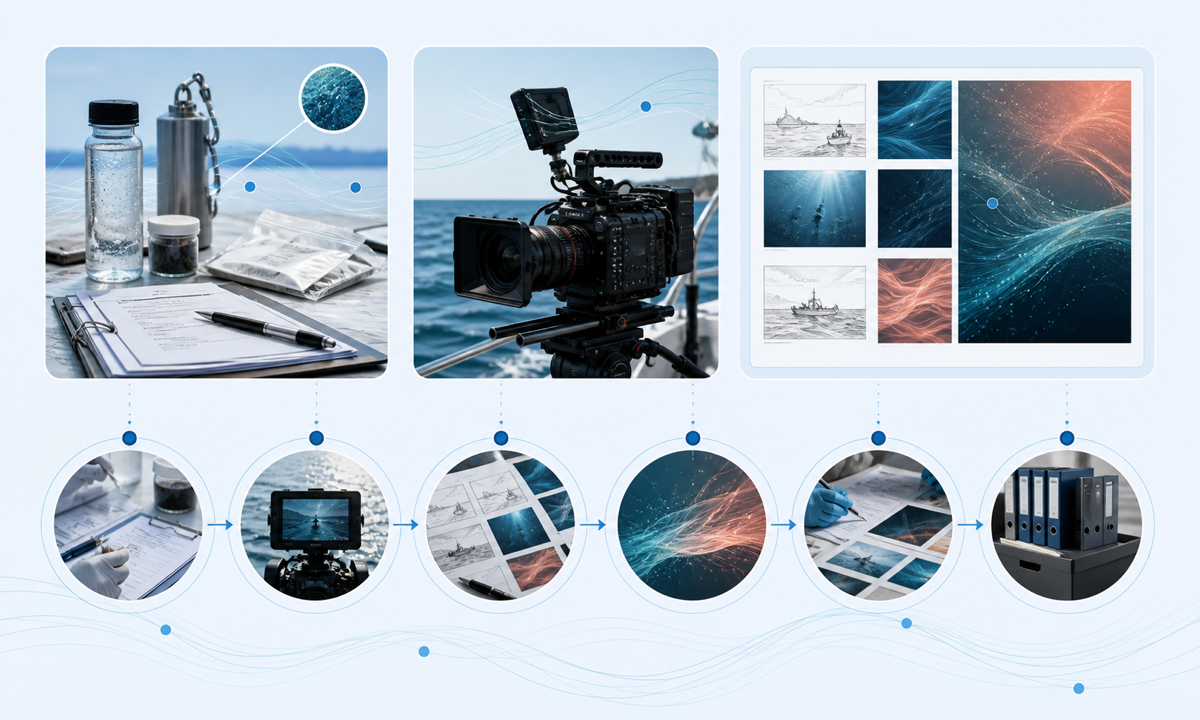
- Freeze the evidence register: program owner, dates, precise locations, permits, methods, staff and volunteer consent, vessels, equipment, waste taxonomy, measured weight, custody, disposal or recovery route, wildlife policy, partners, funding and claim owner.
- Classify each storyboard beat as verified documentary, licensed stock, data visualization or generated illustration; prohibit generated footage from filling evidence gaps.
- Build a source map with releases, location sensitivity, community context, Indigenous or local governance, wildlife safeguards, captions, credits, retention and withdrawal requirements.
- Generate only generic transitions and atmospheric plates with no identifiable cleanup operation, animal interaction, branded participant, recovered quantity, transformation or implied outcome.
- Composite verified footage, maps, measurements, methodology, uncertainty, partner credits, disclosure, donation terms and calls to action in an editable timeline with source-level citations.
- Review with program, scientific, community, wildlife, legal, accessibility and fundraising owners; test captions, audio description, color, localization, claim context, donation flow, correction and archive.
Example prompt variants
- Six-second abstract macro: soft ocean-blue light refracts through suspended translucent recycled-material shapes, one slow lateral camera move, no real debris, wildlife, place, text or impact claim.
- Five-second generic dawn shoreline atmosphere with no people, animals, vessels, structures, identifiable geography or visible waste, subtle locked-off wave movement and a disclosure-safe lower zone.
- Eight-second material-flow metaphor: neutral fragments move through an abstract sorting grid into clearly nonliteral color fields, no branded equipment, recycling result, quantity, word, logo or documentary framing.
Quality checklist
- Every named place, date, person, partner, permit, method, waste type, weight, destination, wildlife statement, funding fact and impact claim links to approved evidence.
- Generated plates are generic, disclosed where appropriate and contain no identifiable operation, rescue, participant, equipment claim, collected quantity or before-and-after proof.
- Communities, workers, volunteers, wildlife, sensitive locations, safety procedures, cultural context and disposal routes are represented only with permission and expert review.
- Captions, methodology, uncertainty, source credits, disclosures, donation terms, audio description, localization, corrections and withdrawal remain editable.
- Evidence register, source map, storyboard classification, prompts, outputs, reviews, claims, publication, corrections and archive remain traceable.
Mistakes to avoid
- Generating volunteers collecting a dramatic volume of plastic and presenting the scene as program footage.
- Inventing an animal rescue, clean-beach reveal, coral recovery or thriving wildlife sequence to manufacture emotional proof.
- Using generic sustainability language to imply measured tonnage, recycling, prevention, community benefit or partner endorsement without records.
- Hiding illustration disclosure in credits while the main edit, narration or fundraising CTA frames generated footage as documentary evidence.
Related AIBase pages
Practical next step
Open the most relevant AIBase generator, run one narrow prompt first, and save the best result before adding more constraints. The fastest way to improve output quality is to compare one variable at a time: subject, camera, background, lighting, then final polish.