
Veo 3.1 Pro Urban Farm Brand Film Prompts
Plan cinematic urban-farm films while keeping real sites, growers, crops, harvests, methods, labor, food-safety, distribution, and impact claims factual.
Quick answer
Use real footage for the farm, building, growers, crops, irrigation, lighting, harvest, packing, delivery, customers, and community programs. Use Veo 3.1 Pro only for clearly illustrative atmospheric transitions such as abstract growth, water, light, or city-grid rhythm. Do not generate a plausible farm or harvest and present it as evidence of yield, freshness, local distribution, water savings, pesticide practice, jobs, food access, or environmental impact.
Who this guide is for
Rooftop farms, vertical farms, hydroponic growers, community gardens, food cooperatives, education programs, restaurants, and agencies creating a brand manifesto, fundraising film, or partnership story.
Recommended model
| Use case | Recommended model | Why |
|---|---|---|
| This workflow | Veo 3.1 Pro for cinematic abstract plates inside a documentary-led edit | Cinematic generation can support transitions and tone while farm-specific operations, people, crop health, distribution, safety, and impact remain grounded in dated evidence. |
AIBase is an independent creative platform. Model names are shown only to identify supported underlying technologies and workflow choices.
Prompt template
Create one [4-7 second] clearly illustrative text-free cinematic plate for an urban-farm brand film. Story job [growth transition / water chapter / city connection / end-card atmosphere]. Abstract subject [soft green light traveling through blank vertical layers / one clear water ripple crossing an unmarked grid / neutral seed-like forms opening without becoming real plants]. Motion [one], camera [one], lens and crop [specific], stable handles. No real or plausible farm, crop, root, grow light, worker, customer, building, rooftop, irrigation equipment, harvest, package, restaurant, city landmark, yield, metric, certification, word, number, logo, voice, or watermark.
Step-by-step workflow
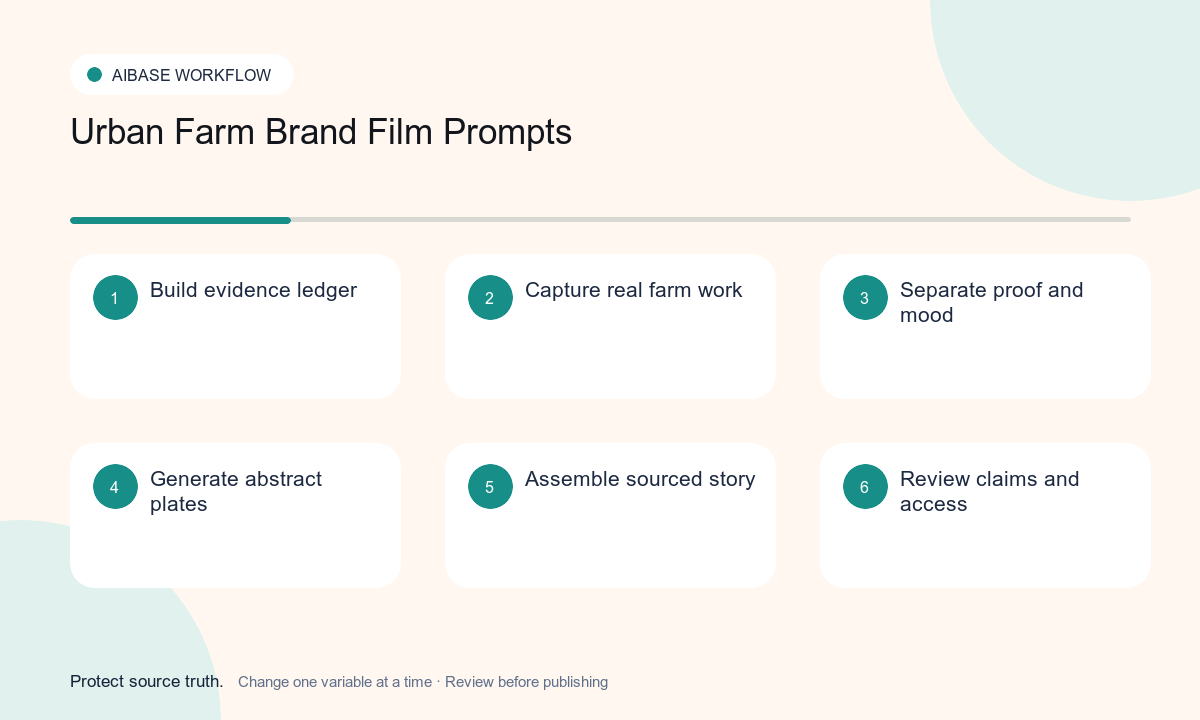
- Build a dated evidence ledger for sites, ownership, growers, crops, methods, inputs, harvest volumes, distribution, customers, food safety, labor, water and energy data, community programs, certifications, partners, and rights.
- Capture authorized real footage of the site, growers, crop stages, systems, harvest, packing, delivery, access features, and consented participants; log each shot and release.
- Separate documentary proof from illustrative atmosphere in the storyboard and label every generated plate before production.
- Generate only abstract connective plates with one motion and no farm, crop, person, equipment, building, city, data, or impact representation.
- Assemble verified footage, narration, captions, audio description, source notes, partner credits, food-safety context, disclosure, access information, and CTA.
- Review crop and method accuracy, labor and child privacy, food-safety representation, claims evidence, partner approval, accessibility, localization, music rights, expiry, corrections, and withdrawal.
Example prompt variants
- Six-second growth transition: soft green light rises through three blank translucent vertical layers and settles, one slow push, no plant, root, farm rack, building, metric, or sound.
- Four-second water chapter plate: one clean ripple moves across an unmarked dark surface and fades, locked camera, no pipe, tank, crop, savings claim, number, or logo.
- Five-second city-connection end plate: warm points align into an abstract grid then hold around an empty title zone, no map, skyline, address, delivery route, partner, or text.
Quality checklist
- Sites, growers, crops, methods, inputs, harvest, distribution, customers, safety, labor, resource data, programs, partners, and certifications match current approved sources.
- Documentary footage is authentic, licensed, correctly dated, and not mixed with generated material in a misleading way.
- Generated plates remain abstract and do not depict a fake farm, crop, worker, building, system, harvest, customer, delivery, or impact result.
- Food safety, labor, privacy, community context, captions, audio description, access, partner rules, music, and disclosure receive appropriate review.
- Evidence ledger, footage log, releases, prompts, generated labels, edit decisions, approvals, expiry, corrections, and withdrawal remain traceable.
Mistakes to avoid
- Generating lush crops, spotless facilities, diverse workers, or abundant harvests and presenting them as the real operation.
- Using abstract water or green imagery as proof of savings, pesticide practice, freshness, nutrition, carbon reduction, or sustainability.
- Creating synthetic community members, students, restaurants, or deliveries to imply access, demand, education, partnership, or impact.
- Letting cinematic mood replace verifiable facts about location, availability, seasonality, food safety, labor, pricing, and distribution.
Related AIBase pages
Practical next step
Open the most relevant AIBase generator, run one narrow prompt first, and save the best result before adding more constraints. The fastest way to improve output quality is to compare one variable at a time: subject, camera, background, lighting, then final polish.