
Seedance 2 Soap Cutting Process Video Prompts from Studio Photos
Animate one source-led soap-cutting action with stable hands, blade, loaf geometry, texture, and clearly limited craft-process context.
Quick answer
Use an authorized frame that already shows the real soap loaf, cutter, hands, board, and a plausible cut start. Animate only one short downward cut and a stable end state. Lock loaf dimensions, layers, inclusions, texture, blade geometry, finger count, grip, contact, camera, and light. Treat the result as illustrative unless the maker verifies the exact batch and method; add ingredients, cure time, safety, skin, sustainability, and handmade claims only from approved records.
Who this guide is for
Soap makers, craft studios, retailers, educators, and social teams creating restrained behind-the-scenes motion from their own process photography.
Recommended model
| Use case | Recommended model | Why |
|---|---|---|
| This workflow | Seedance 2 image-to-video for one bounded source-led cut | A real first frame anchors the batch and workspace, while a single motion request limits tool, hand, and product drift. |
AIBase is an independent creative platform. Model names are shown only to identify supported underlying technologies and workflow choices.
Prompt template
Animate the uploaded authorized soap-cutting photo as the exact first frame. Over [4-5 seconds], move only the existing [wire cutter / straight blade] through one short, physically plausible downward cut along the visible guide, then stop with the new bar supported on the board. Preserve exact soap loaf length, width, height, layers, colors, swirl pattern, inclusions, surface texture, existing cuts, cutter frame, wire or blade, hand count, fingers, grip, sleeves, board, crumbs, tools, background, crop, camera, light, shadows, and batch context. No extra slice, instant separation, changing swirl, multiplying bars, bent blade, duplicated hand, ingredient claim, lather, skin use, text, sound, or watermark.
Step-by-step workflow
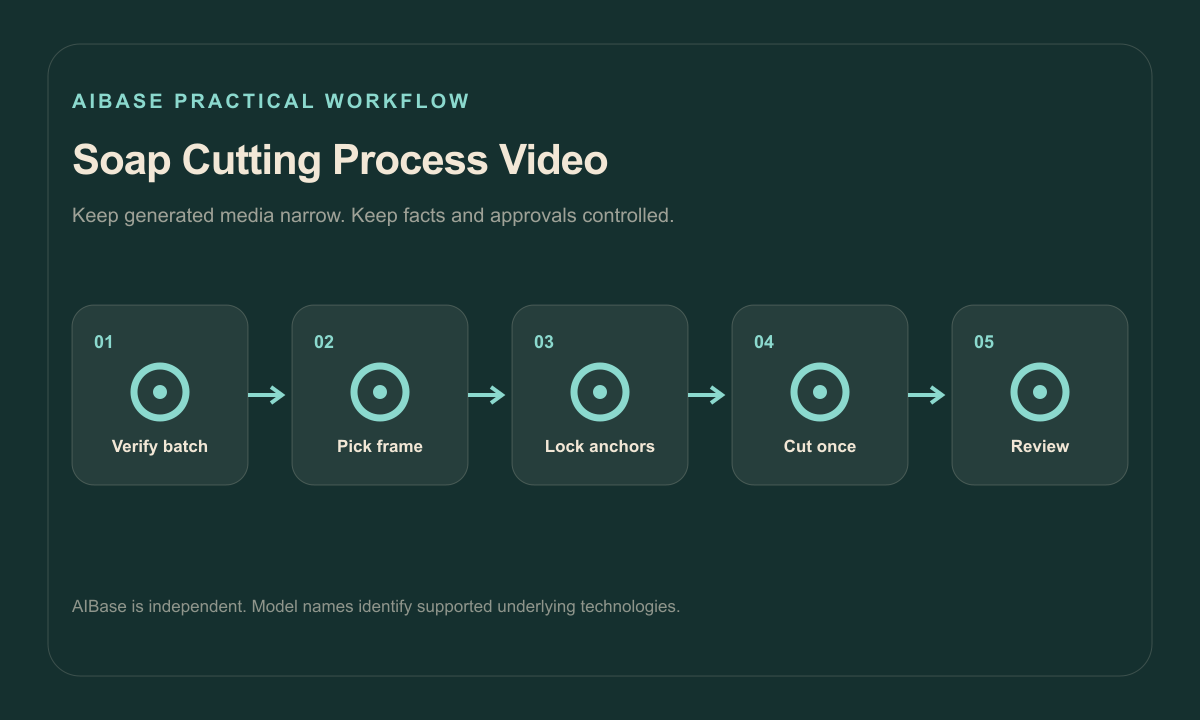
- Confirm maker, photographer, performer, workspace, product, batch, music, and publication rights plus the factual reviewer.
- Verify the photographed stage, cutting tool, batch dimensions, decorative inclusions, safety context, and any handmade or ingredient statement.
- Choose a sharp frame with visible tool contact and list the loaf, pattern, blade, hands, board, crumbs, camera, and light as anchors.
- Describe one start, downward path, contact, stop, and stable end; generate a locked-camera version before any subtle camera motion.
- Review every frame for hand anatomy, blade continuity, tool collision, slice thickness, pattern drift, multiplying bars, crumbs, shadows, and stable ending.
- Add verified batch caption, illustrative-process disclosure, accessibility, licensed audio, and product link in editable post-production layers.
Example prompt variants
- Four-second locked macro from the authorized frame: the existing wire descends through one marked cut and stops; preserve loaf geometry, lavender-white swirl, wire frame, both hands, board and crumbs.
- Five-second side view: the approved straight blade completes only the final centimeter of one existing cut, then holds; preserve striped soap layers, blade, glove, ruler marks, table and camera.
- Three-second no-cut alternative: one authorized finished bar remains fixed while a nearby loose paper label edge moves slightly in studio air; preserve bar texture, stamp, packaging and light, no lather or claim.
Quality checklist
- The batch, loaf, layers, colors, swirl, inclusions, cut stage, tool, hands, workspace, and camera match the authorized source.
- One cut follows plausible tool contact, timing, resistance, gravity, slice thickness, and a stable ending.
- Hands, fingers, wire or blade, loaf geometry, patterns, crumbs, shadows, and bar count do not morph or duplicate.
- Ingredients, cure time, handmade origin, skin effects, safety, sustainability, price, and availability are verified editable claims.
- Sources, releases, batch facts, prompt, output, frame review, disclosure, audio, approval, and retention remain traceable.
Mistakes to avoid
- Animating an entire mixing, pouring, curing, cutting, stamping, and packaging sequence from one still.
- Accepting a blade that bends, passes through fingers, loses contact, changes thickness, or produces extra bars.
- Letting colors, swirl patterns, botanicals, stamps, ingredients, or batch identity change during the cut.
- Presenting illustrative motion as documentary proof of handmade origin, formulation, hygiene, or skin benefit.
Related AIBase pages
Practical next step
Open the most relevant AIBase generator, run one narrow prompt first, and save the best result before adding more constraints. The fastest way to improve output quality is to compare one variable at a time: subject, camera, background, lighting, then final polish.