
Seedance 2 Handmade Product Process Video Prompts
Animate authorized handmade-product photos with Seedance 2 using one real process action per shot, stable tools and hands, accurate materials, maker consent, and honest assembly.
Quick answer
Document the real making sequence and use one authorized source frame for each step. Ask for one small, physically possible action—pulling thread, turning clay, brushing glaze, closing a mold, or placing a finished item—while locking hands, tools, materials, workspace, and product state. Assemble separate clips in the true order and do not invent a maker, process, ingredient, or handmade claim.
Who this guide is for
Independent makers, craft studios, marketplace sellers, workshop educators, and creative teams producing short process reels for ceramics, leatherwork, textiles, candles, paper goods, jewelry, or woodcraft.
Recommended model
| Use case | Recommended model | Why |
|---|---|---|
| This workflow | Seedance 2 image-to-video | A reference-led clip workflow can add restrained motion to documented craft stages while keeping the photographed workspace and product state as the visual anchor. |
AIBase is an independent creative platform. Model names are shown only to identify supported underlying technologies and workflow choices.
Prompt template
Animate the uploaded authorized [craft-stage] photo as the exact first frame for [4-6 seconds]. Verified process step: [one documented action only]. Subject [hands/tool/material/product state]. Motion [single low-amplitude physical action], camera [locked or one subtle move], lighting unchanged. Preserve maker identity if visible, hand count and anatomy, tool type and grip, material quantity, grain or viscosity, workpiece dimensions, partially completed state, workspace layout, fixtures, safety equipment, labels, shadows, crop, and color. Do not jump to a finished product, add hands or tools, change material, reverse gravity, invent sparks or smoke, show unsafe technique, add text, logo, watermark, undocumented ingredient, certification, origin, sustainability, speed, or handmade claim.
Step-by-step workflow
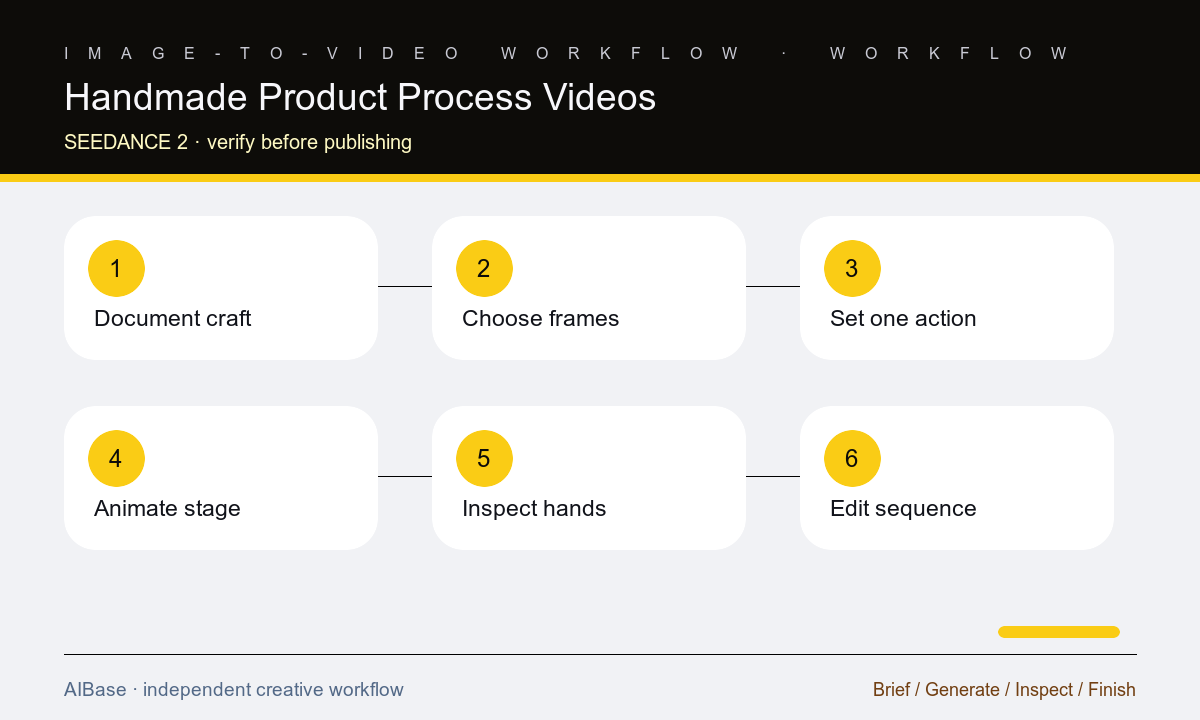
- Record the real process order, materials, tools, safety requirements, maker permission, product state at each stage, and claims the business can substantiate.
- Select one clean authorized photo per stage and note protected hands, tool grips, workpiece geometry, material behavior, fixtures, labels, background, and crop.
- Choose one observable action that can plausibly begin from each still, keeping the amplitude small and the camera locked until physical continuity is reliable.
- Generate each stage as a separate short clip, stating the preserved start state before motion and rejecting any leap to an undocumented result.
- Inspect fingers, tool contact, material deformation, particles, liquid, heat, flame, dust, machine guards, workspace objects, light, and end-frame stability.
- Edit selected clips in the verified order with licensed sound, approved captions, process notes, product copy, disclosure, and a destination that matches the shown item.
Example prompt variants
- Five-second pottery-stage clip from the authorized wheel photo: both adult hands maintain the documented grip as the clay cylinder turns slowly once, locked camera, preserve finger count, clay height, wall thickness, wheel, apron, splash pan, wet texture, and no instant finished vase.
- Four-second leather-stitching clip: the visible hand pulls the existing thread through one prepared hole while the other hand and tool remain stable, subtle push-in, preserve hide grain, stitch spacing, needle, thread color, edge, mat, and no added logo.
- Six-second candle-pour stage using the authorized workshop frame: a small continuous wax stream enters the centered vessel without overflow, preserve pitcher, wick count and position, vessel, wax color, gloves, bench, shadows, and no open flame or ingredient claim.
Quality checklist
- Every shot corresponds to a documented process stage, authorized maker or hands, real tool, material, workspace, product, and substantiated claim.
- Hands, fingers, grip, tool contact, workpiece shape, material volume, grain, flow, heat response, particles, fixtures, and shadows remain physically coherent.
- Each clip contains one readable action without a time jump, instant completion, new tool, added person, reversed process, unsafe technique, or camera conflict.
- The assembled sequence keeps the true order and separates generated motion from approved captions, logos, ingredients, origin, certifications, pricing, and CTA.
- Rights, safety, maker consent, source frames, prompts, review notes, disclosure, captions, sound, and destination product are documented.
Mistakes to avoid
- Prompting raw material to become a finished product in one shot and creating a process that never occurred.
- Using broad language such as artisan hands working quickly, which encourages extra fingers, changing tools, unsafe grips, and identity drift.
- Adding fire, sparks, dust, fumes, blades, boiling liquid, or machine motion for drama without reflecting the real process and safety setup.
- Implying handmade, local, sustainable, natural, traditional, or single-maker production when the claim and shown process are not documented.
Related AIBase pages
- Open Seedance 2 image-to-video
- Use the Seedance image-to-video guide
- Animate product photos
- Compare Seedance 2 and Wan 2.7
Practical next step
Open the most relevant AIBase generator, run one narrow prompt first, and save the best result before adding more constraints. The fastest way to improve output quality is to compare one variable at a time: subject, camera, background, lighting, then final polish.