
Veo 3.1 Pro Recycled Paper Mill Brand Film Prompts
Plan cinematic recycled-paper mill films while keeping real facilities, feedstock, process, workers, water, energy, certifications, traceability, and impact claims evidence-led.

Quick answer
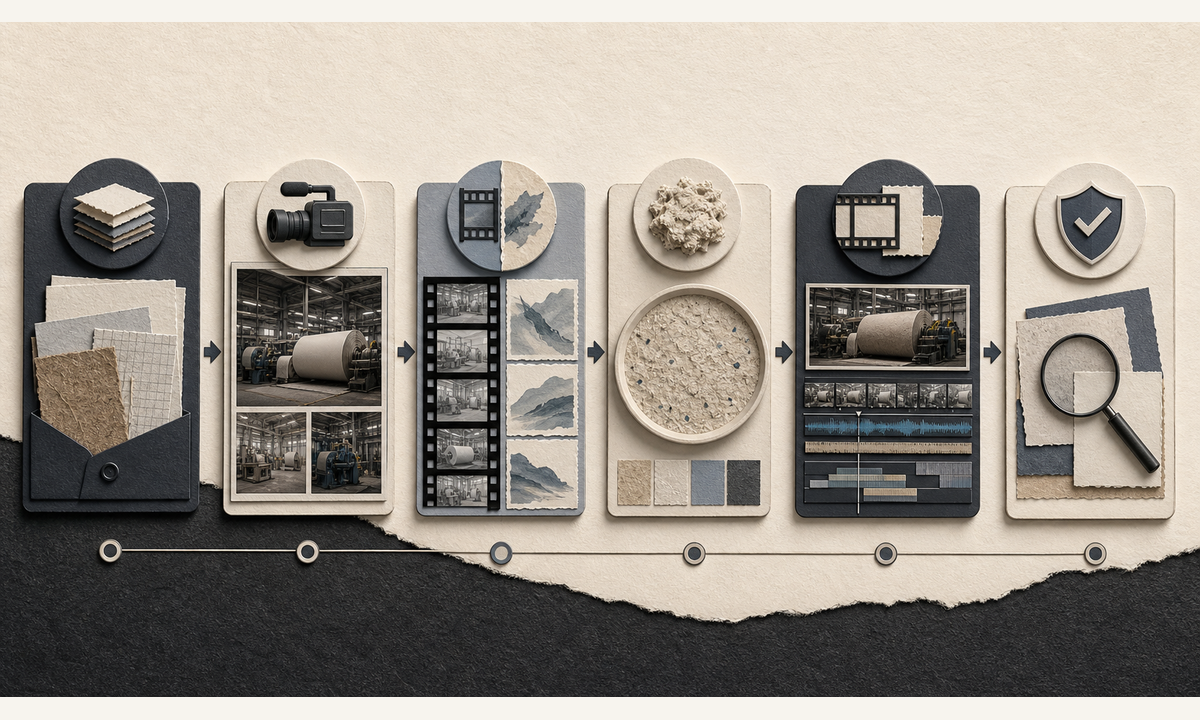
Use real authorized footage for the mill, recovered-paper feedstock, sorting, pulping, screening, cleaning, de-inking if applicable, stock preparation, forming, pressing, drying, winding, converting, water treatment, energy systems, workers, safety controls, products, and shipping. Use Veo 3.1 Pro only for clearly illustrative fiber, water, or sheet-formation transitions that cannot be mistaken for a real facility or result. Do not generate a clean mill, closed-loop system, recycled percentage, certification, emissions reduction, water saving, zero-waste outcome, worker, or customer as evidence.
Who this guide is for
Paper mills, packaging manufacturers, tissue and board producers, recycling organizations, print and publishing suppliers, sustainability teams, and agencies creating corporate, customer, recruitment, or education films.
Recommended model
| Use case | Recommended model | Why |
|---|---|---|
| This workflow | Veo 3.1 Pro for cinematic abstract plates inside an evidence-led mill film | Cinematic generation can support material transitions and chapter rhythm while facility-specific operations, people, safety, chain of custody, resource data, and impact remain documented in authentic footage. |
AIBase is an independent creative platform. Model names are shown only to identify supported underlying technologies and workflow choices.
Prompt template
Create one [4-7 second] clearly illustrative text-free cinematic plate for a recycled-paper mill brand film. Story job [fiber transition / water chapter / sheet formation metaphor / end-card atmosphere]. Abstract subject [neutral paper fibers slowly aligning / one clean ripple passing beneath a translucent sheet / layered pulp-like textures becoming a smooth blank plane]. Motion [one], camera [one], lens and crop [specific], stable edit handles. No real or plausible mill, pulper, conveyor, roll, bale, pipe, treatment plant, worker, vehicle, forest, tree, wildlife, product package, recycling symbol, certification, percentage, emissions cue, savings claim, word, number, logo, voice, or watermark.
Step-by-step workflow
- Build a dated evidence ledger for sites, ownership, feedstock sources and grades, recycled-content calculation, process steps, additives, outputs, waste, water, energy, emissions, safety, labor, certifications, chain of custody, products, customers, and rights.
- Capture authorized real footage of the facility exterior, receiving, sorting, pulping, cleaning, stock preparation, paper machine, rolls, lab, water treatment, energy systems, workers, safety practices, storage, and shipping; log every shot.
- Separate documentary proof, licensed archive, data visualization, and clearly illustrative generated atmosphere in the storyboard and disclosure plan.
- Generate only abstract fiber, water, or blank-sheet connective plates with one motion and no facility, equipment, people, products, forests, data, certification, or impact representation.
- Assemble authentic footage, sourced diagrams, narration, captions, audio description, safety context, worker releases, evidence notes, certification qualifiers, disclosure, and CTA.
- Review process accuracy, trade confidentiality, worker safety and privacy, environmental and recycled-content claims, certification rules, partner approval, accessibility, music, expiry, corrections, and withdrawal.
Example prompt variants
- Six-second fiber transition: pale recovered-paper fibers drift in a dark neutral liquid-like field, align into one soft blank sheet plane and hold, no machine, mill, recycling mark, tree, claim, or sound.
- Four-second water chapter plate: one restrained ripple passes under a translucent cream paper layer, locked macro camera, no pipe, tank, treatment equipment, closed-loop implication, metric, or logo.
- Five-second end-card atmosphere: stacked blank paper edges catch warm side light while the camera makes one slow push toward an empty title zone, no product label, certification, percentage, forest, or text.
Quality checklist
- Sites, feedstock, recycled-content method, process, additives, products, waste, water, energy, emissions, safety, labor, certifications, chain of custody, and customers match current evidence.
- Documentary and archive footage is authentic, licensed, correctly dated, site-specific, and not blended with generated material misleadingly.
- Generated plates remain abstract and contain no fake mill, equipment, worker, forest, product, recycling mark, certification, metric, or impact result.
- Safety, privacy, confidentiality, environmental claims, recycled-content qualifiers, captions, audio description, sourcing, music, and disclosure receive appropriate review.
- Evidence ledger, footage log, releases, prompts, generated labels, edit decisions, approvals, expiry, corrections, and withdrawal remain traceable.
Mistakes to avoid
- Generating spotless equipment, perfect bales, abundant recycled feedstock, diverse workers, or pristine water and presenting them as the real mill.
- Using fiber, water, leaf, tree, loop, or green imagery as proof of recycled content, circularity, savings, low emissions, forest benefit, or zero waste.
- Showing unsafe proximity to machinery, missing PPE, invented process order, or hidden systems that conflict with the actual facility.
- Letting cinematic mood replace cited definitions, boundaries, baselines, dates, verification, certification scope, and facility-specific resource data.
Related AIBase pages
Practical next step
Open the most relevant AIBase generator, run one narrow prompt first, and save the best result before adding more constraints. The fastest way to improve output quality is to compare one variable at a time: subject, camera, background, lighting, then final polish.