
Veo 3.1 Pro Furniture Craft Film Prompts for Cinematic B-Roll
Plan cinematic furniture atmosphere shots while keeping real makers, materials, construction, provenance, and sustainability claims in verified footage.
Quick answer
Use Veo 3.1 Pro for non-evidentiary atmosphere such as abstract wood grain, empty light, or generic material shadows. Use verified footage for actual craftspeople, workshops, joinery, wood species, origin, finish, dimensions, certifications, and sustainability claims.
Who this guide is for
Furniture brands, studios, retailers, and editors cutting cinematic atmosphere around real product and maker documentation.
Recommended model
| Use case | Recommended model | Why |
|---|---|---|
| This workflow | Veo 3.1 Pro for controlled cinematic atmosphere | It supports deliberate camera and light direction when a shot does not need to prove a person, workshop, construction method, or product claim. |
AIBase is an independent creative platform. Model names are shown only to identify supported underlying technologies and workflow choices.
Prompt template
Create a [duration] text-free cinematic furniture atmosphere shot: [one generic material or empty-light subject]. Camera: [one controlled move], light: [specific], palette: [specific]. This is illustrative B-roll. No real maker, workshop, furniture SKU, joinery claim, wood species, origin, certification, price, word, logo, sound, or watermark.
Step-by-step workflow
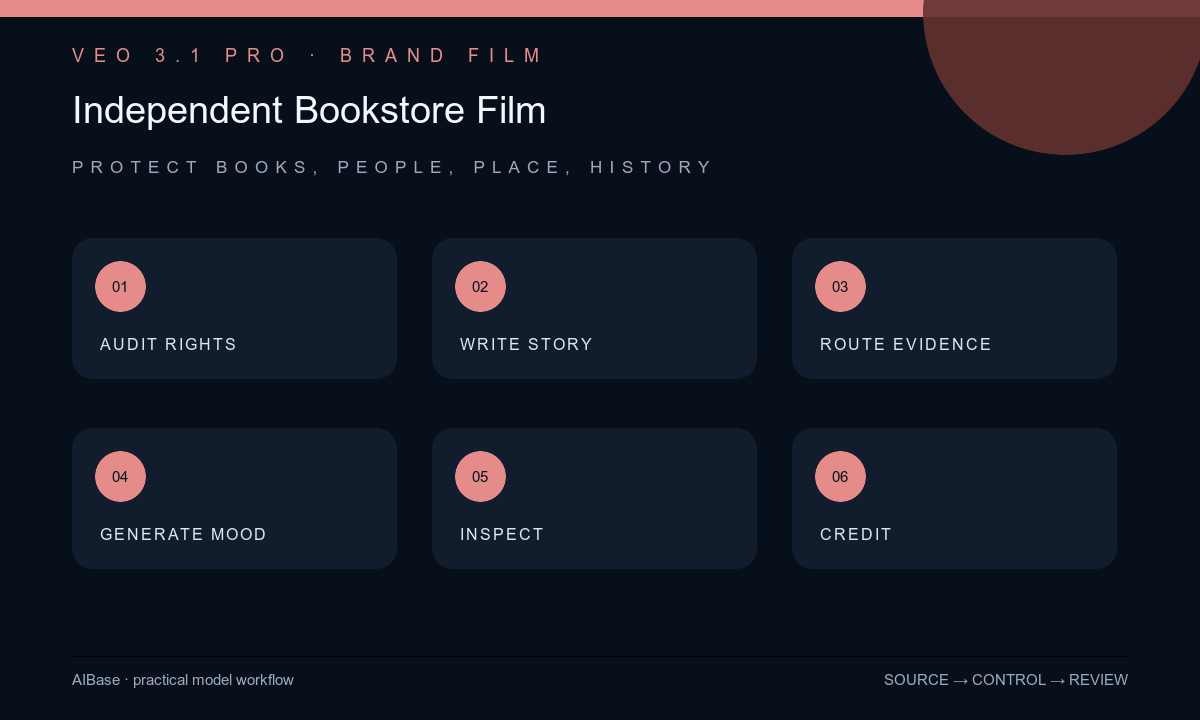
- Make a truth sheet for products, materials, makers, construction, origin, certifications, and permissions.
- Classify each shot as real proof, approved product shot, or generic atmosphere.
- Generate only one non-evidentiary visual job per clip.
- Film real people, workshop, products, measurements, and labels where facts need evidence.
- Composite verified narration, captions, disclosures, and CTA in post.
- Review every claim, source cue, audio right, crop, and destination before release.
Example prompt variants
- Five-second macro of anonymous wood grain crossed by a slow band of warm light, one gentle push, no furniture, person, workshop, text, or logo.
- Four-second empty plaster wall with a moving shadow from an unseen window, locked camera, no product, maker, claim, or sound.
- Six-second abstract textile texture with shallow focus, no SKU, label, certification, word, or watermark.
Quality checklist
- Generated footage is clearly atmospheric and does not carry factual product evidence.
- Real makers, materials, construction, provenance, and claims are separately verified.
- Objects, motion, light, and edit handles remain stable.
- Narration, captions, disclosures, and CTA are accurate and editable.
- Sources, prompts, approvals, and usage rights remain traceable.
Mistakes to avoid
- Using generated workshops or artisans as proof of production.
- Inventing joinery, certifications, wood species, or sustainability cues.
- Showing an unverified construction process as documentary footage.
- Hardcoding claims and offers into generated video.
Related AIBase pages
Practical next step
Open the most relevant AIBase generator, run one narrow prompt first, and save the best result before adding more constraints. The fastest way to improve output quality is to compare one variable at a time: subject, camera, background, lighting, then final polish.