
Best AI Workflow for Product Care Guide Images and Videos
Route cleanup, reference-led diagrams, layout backgrounds, and bounded motion while keeping care steps, materials, hazards, tools, warranties, and product revisions accurate.
Quick answer
Start from the approved manual and a product-revision truth sheet, not from a generic prompt. Use Nano Banana 2 for narrow cleanup, Nano Banana Pro for reference-led product-state concepts, GPT Image 2 or Seedream 5.0 Lite for text-free layout backgrounds, Seedance or Wan for one documented care motion, Veo 3.1 Fast for generic transitions, and HappyHorse only when an authorized presenter portrait needs restrained micro-motion. Keep instructions, warnings, timings, quantities, tools, compatibility, warranty, disposal, and support links as verified editable content.
Who this guide is for
Ecommerce brands, hardware and appliance teams, furniture and apparel retailers, support organizations, technical writers, service networks, and agencies producing web, packaging, QR, email, social, and help-center care guides.
Recommended model
| Use case | Recommended model | Why |
|---|---|---|
| This workflow | A routed AIBase-supported stack chosen by care-guide asset job | Product cleanup, exact state depiction, decorative layouts, mechanical motion, generic transitions, and identity-led presentation have different risk profiles; routing keeps the approved manual authoritative. |
AIBase is an independent creative platform. Model names are shown only to identify supported underlying technologies and workflow choices.
Prompt template
Product care guide asset job: [localized cleanup / exact reference-led state / text-free layout background / source-led care motion / generic transition / consented presenter micro-motion]. Product [exact SKU and revision], approved manual step [specific], channel and ratio [specific], protected instruction, warning, tool, timing, quantity, support, and CTA zones [specific]. When references are used, preserve exact product geometry, materials, finish, fasteners, openings, controls, labels, condition, tool, contact point, hand safety, order of operations, and source-supported state. No invented step, liquid, chemical, tool, quantity, duration, disassembly, internal part, result, performance claim, word, number, logo, sound, or watermark.
Step-by-step workflow
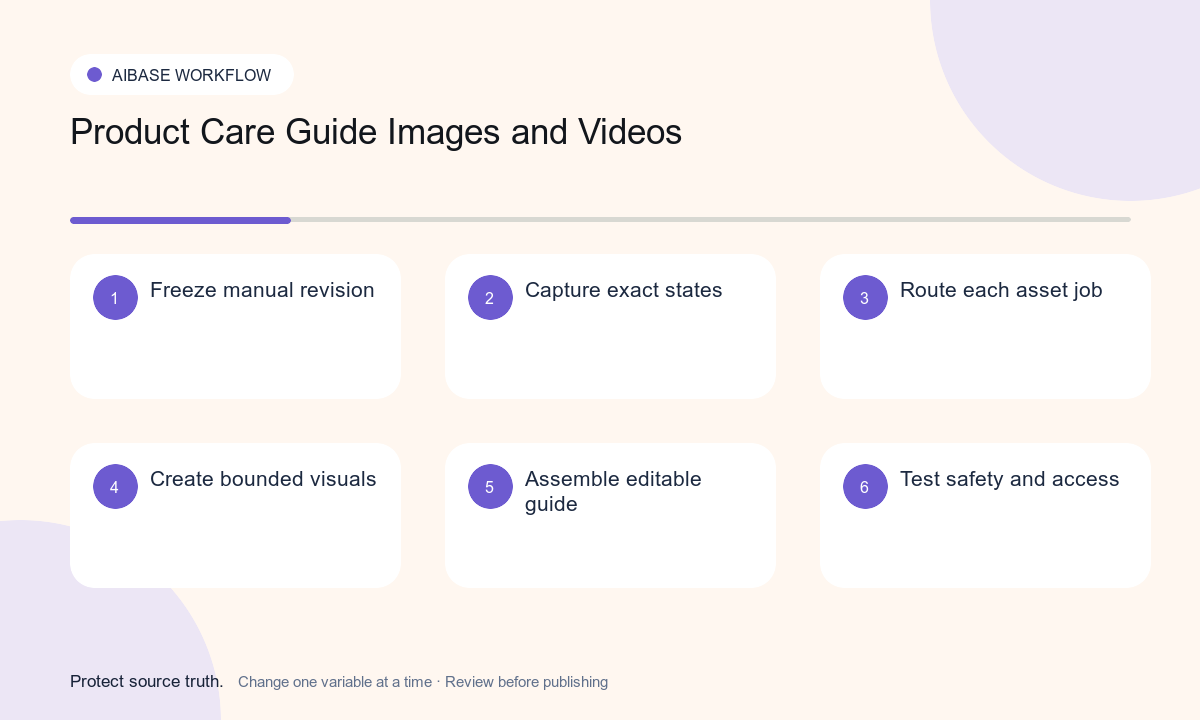
- Freeze the approved manual by SKU and revision: materials, finishes, care steps, order, tools, consumables, quantities, timings, prohibitions, hazards, PPE, disposal, warranty limits, markets, and support owner.
- Capture authorized product states before, during, and after each approved step plus tools, contact points, labels, fasteners, openings, controls, scale, and safe hand positions.
- Route dust or background cleanup to Nano Banana 2 and exact reference-led state concepts to Nano Banana Pro; stop when a hidden part or undocumented result would need invention.
- Use GPT Image 2 or Seedream 5.0 Lite for text-free page, card, email, and social backgrounds with protected instruction and warning zones.
- Use Seedance 2 or Wan 2.7 for one documented mechanical or material movement, Veo 3.1 Fast for generic transitions, and HappyHorse only for approved presenter micro-motion.
- Assemble real product plates, verified steps, warnings, tools, quantities, timings, captions, audio description, disclosure, support link, version, and locale in editable masters.
- Test every guide with product, safety, legal, support, accessibility, localization, warranty, mobile, print, link, QR, revision, expiry, correction, and rollback owners.
Example prompt variants
- Nano Banana 2 cleanup: remove only documented dust from the approved unplugged appliance exterior, preserve controls, vents, labels, seams, finish, scratches, cord, shadow, and product condition.
- Nano Banana Pro state concept: use approved before and after references for one removable filter, preserve exact housing, latch, arrows zone, filter orientation, tabs, seals, and no hidden interior beyond sources.
- Seedream 5.0 Lite background family: coordinated text-free 16:9 help hero, 4:5 social card, and A4 section background with protected step, warning, tool, and support zones, no product, instruction symbol, text, or number.
- Wan 2.7 motion: animate one documented cap quarter-turn on the approved care product, preserve cap threads, bottle, label zone, hand-free frame, liquid state, camera, and stop before pouring.
Quality checklist
- SKU, revision, materials, finish, steps, order, tools, consumables, quantities, timings, prohibitions, hazards, PPE, disposal, warranty, and support match the approved manual.
- Product geometry, controls, fasteners, openings, labels, condition, tools, contact points, hands, states, and motion remain source-faithful and safe.
- Generated content contains no invented disassembly, hidden part, chemical, liquid behavior, result, repair, sanitization, performance, compatibility, or warranty implication.
- Instructions, warnings, quantities, timings, captions, audio description, disclosure, support, version, QR, links, and locale remain editable and accessible.
- Manual source, revision map, references, prompts, outputs, specialist reviews, publication, expiry, correction, withdrawal, and rollback remain traceable.
Mistakes to avoid
- Using generic AI instructions instead of the exact approved manual for the product revision and market.
- Generating hidden mechanisms, disassembly, chemicals, tools, PPE, quantities, timings, or finished results that references do not document.
- Making a visually smooth care action that is unsafe, voids the warranty, damages materials, or bypasses required shutdown and hazard steps.
- Publishing attractive guidance without revision control, accessible text, warnings, support links, localization, specialist approval, and a fast correction path.
Related AIBase pages
- Open all AI image models
- Open all AI video models
- Compare text-to-image and image-to-image for product photos
- Turn product photos into social video ads
Practical next step
Open the most relevant AIBase generator, run one narrow prompt first, and save the best result before adding more constraints. The fastest way to improve output quality is to compare one variable at a time: subject, camera, background, lighting, then final polish.