
Seedance 2 Candle-Making Process Video Prompts from Workshop Photos
Animate short candle-making process shots with Seedance 2 while preserving real tools, vessels, wax state, wick placement, labels, hands, safety, and production truth.
Quick answer
Animate one verified micro-action per source photo: center a wick, make a short controlled pour, place a lid, or apply a label. Do not ask one clip to transform raw wax into a finished candle. Preserve vessel count, wick position, wax level and state, hands, tools, labels, bench layout, and safety context, and use real footage whenever the shot is intended to prove ingredients, temperature, labor, cleanliness, or manufacturing practice.
Who this guide is for
Candle studios, makers, ecommerce brands, craft educators, and social teams turning authorized workshop stills into illustrative process reels, product-page loops, or short behind-the-scenes sequences.
Recommended model
| Use case | Recommended model | Why |
|---|---|---|
| This workflow | Seedance 2 image-to-video for bounded craft micro-actions | An image-led clip can explore small process motion while the approved frame anchors the vessel, tool, maker, material state, and workspace. |
AIBase is an independent creative platform. Model names are shown only to identify supported underlying technologies and workflow choices.
Prompt template
Animate the uploaded authorized candle-workshop photo as one [3-5 second] illustrative process shot. Preserve exact vessel count and shape, wick count and position, wax level, wax state, color, tools, thermometer or pitcher, hands, gloves, labels, bench objects, lighting, crop, and current production stage. Motion: [one small verified action] with physically plausible contact and liquid behavior. Camera [locked / one slow move], stable final second. Do not add or remove flame, wick, wax, fragrance ingredient, dye, vessel, label, hand, tool, spill, smoke, steam, spark, finished product, safety equipment, claim, text, or watermark.
Step-by-step workflow
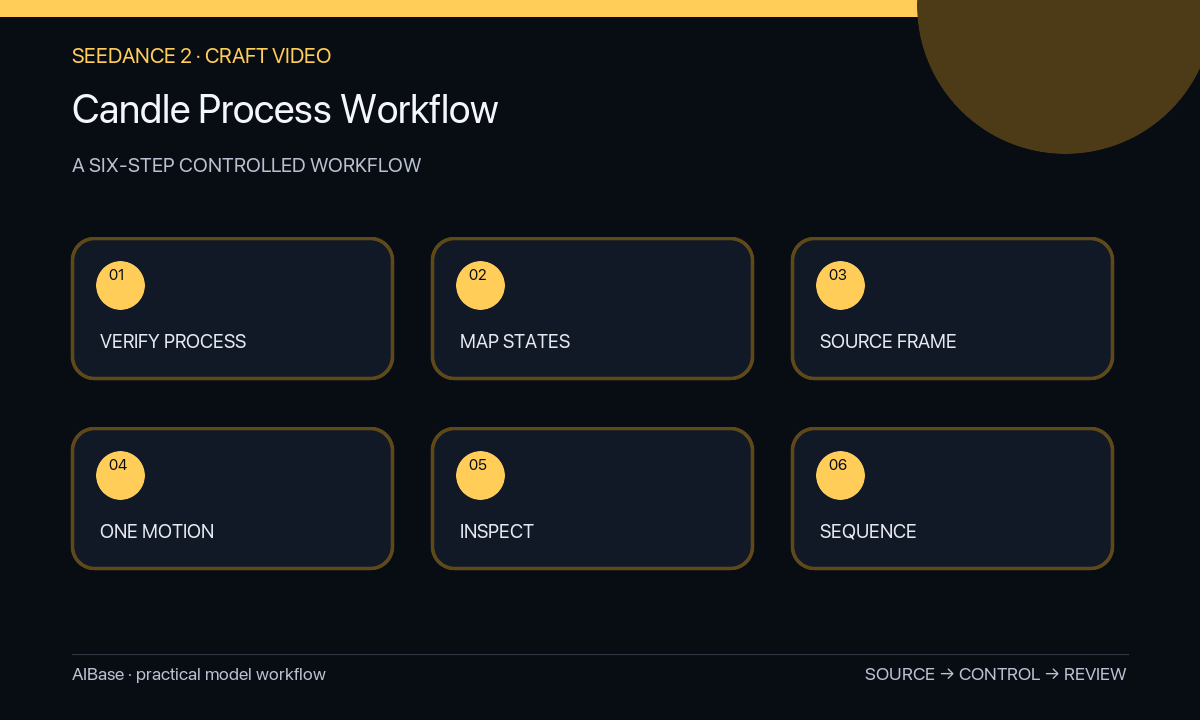
- Confirm footage and worker consent, product batch, real step order, approved ingredients and claims, vessel and wick specification, safety guidance, and which scenes need documentary capture.
- Map the sequence into discrete states such as vessel prep, wick centering, verified pour, cure, trim, label, lid, and finished reveal; never bridge an undocumented transformation.
- Choose a source frame with clear hand-tool-material contact, visible wax boundary, unobstructed wick, stable vessel, and enough crop margin for one small motion.
- Prompt one three-to-five-second action with a locked camera or one slow move, modest liquid displacement, and no request to complete another stage.
- Inspect every frame for hands, grip, pitcher lip, wax flow, level, viscosity, wick count and centering, vessel shape, labels, tools, spills, flame, reflections, and final stability.
- Edit approved clips in real process order, add exact captions and safety or ingredient information in post, disclose illustrative generation when needed, and retain sources and approvals.
Example prompt variants
- Four-second locked close-up from the approved frame: a gloved hand makes one short steady wax pour into the existing vessel, preserve pitcher, wax color and level, centered wick, wick holder, jar, bench, reflections, and every tool; no spill or new steam.
- Three-second wick-centering detail: the existing wooden guide shifts a few millimeters into the verified centered position, preserve hand grip, wick count, jar geometry, empty vessel state, surrounding tools, camera, and no wax appearance.
- Four-second labeling shot from the approved source: the maker presses only the already aligned label edge once, preserve exact label artwork and spelling, jar, lid position, hands, bench, crop, and finished candle state; no redesigned packaging.
Quality checklist
- The action matches the verified production order and the before-state and after-state differ only by that micro-action.
- Hands, tools, contact, wax flow, vessel, wick, label, flame state, workspace, and safety context remain physically plausible.
- Counts, shapes, ingredient appearance, wax level, color, batch state, branding, and product configuration stay stable.
- The clip does not imply ingredient purity, hand-poured status, cure time, burn quality, safety, sustainability, or production scale without evidence.
- Source photos, process map, prompts, outputs, factual review, disclosure, captions, and final sequence remain traceable.
Mistakes to avoid
- Requesting melt, scent, dye, pour, cure, trim, label, and light in a single transformation clip.
- Animating a source with hidden wick or tool contact and allowing the model to invent hands, mechanics, or material state.
- Letting wax level, vessel count, wick position, label, tools, flame, or batch stage change between frames.
- Presenting generated workshop motion as proof of ingredients, labor, safety, cleanliness, production volume, or burn performance.
Related AIBase pages
- Open Seedance 2.0
- Create handmade product process videos
- Animate a candle flame packshot
- Build product photo-to-video shots
Practical next step
Open the most relevant AIBase generator, run one narrow prompt first, and save the best result before adding more constraints. The fastest way to improve output quality is to compare one variable at a time: subject, camera, background, lighting, then final polish.