
Seedance 2 Jewelry Engraving Process Video Prompts
Turn authorized engraving references into focused process clips while preserving jewelry geometry, tools, hands, text accuracy, material behavior, and artisan safety.
Quick answer
Use a real engraving still or short sequence that shows the exact blank, guide marks, graver or machine, hand position, cut direction, metal response, debris, and finished state. Animate one documented stroke or tool pass at a time. If letters, numbers, hallmarks, names, dates, signatures, serials, or custom artwork matter, use real footage or composite the verified engraving; do not let the model invent or correct them.
Who this guide is for
Jewelry studios, engravers, watchmakers, personalization shops, craft educators, and social editors creating short process clips from approved bench photography.
Recommended model
| Use case | Recommended model | Why |
|---|---|---|
| This workflow | Seedance 2 image-to-video for one source-supported engraving action | A bounded tool-and-material movement can communicate craft rhythm while strict reference locks protect product geometry, hands, engraving content, and safe technique. |
AIBase is an independent creative platform. Model names are shown only to identify supported underlying technologies and workflow choices.
Prompt template
Animate the uploaded authorized engraving reference as the exact first frame. Motion only: the existing [hand graver / pneumatic tool / machine cutter] follows the documented guide for one [short line / curve / hatch pass] over [duration], then lifts and holds. Preserve exact jewelry blank, dimensions, metal color and finish, setting, stone, edge, guide marks, verified engraved content, tool shape and angle, vise, fingers, nails, grip, wrist, protective setup, bench, chips, reflections, crop, focus, camera, and light. No new letter, number, hallmark, name, date, logo, design completion, extra hand, finger drift, tool duplication, stone damage, metal melting, sparks, unsafe contact, sound, or watermark.
Step-by-step workflow
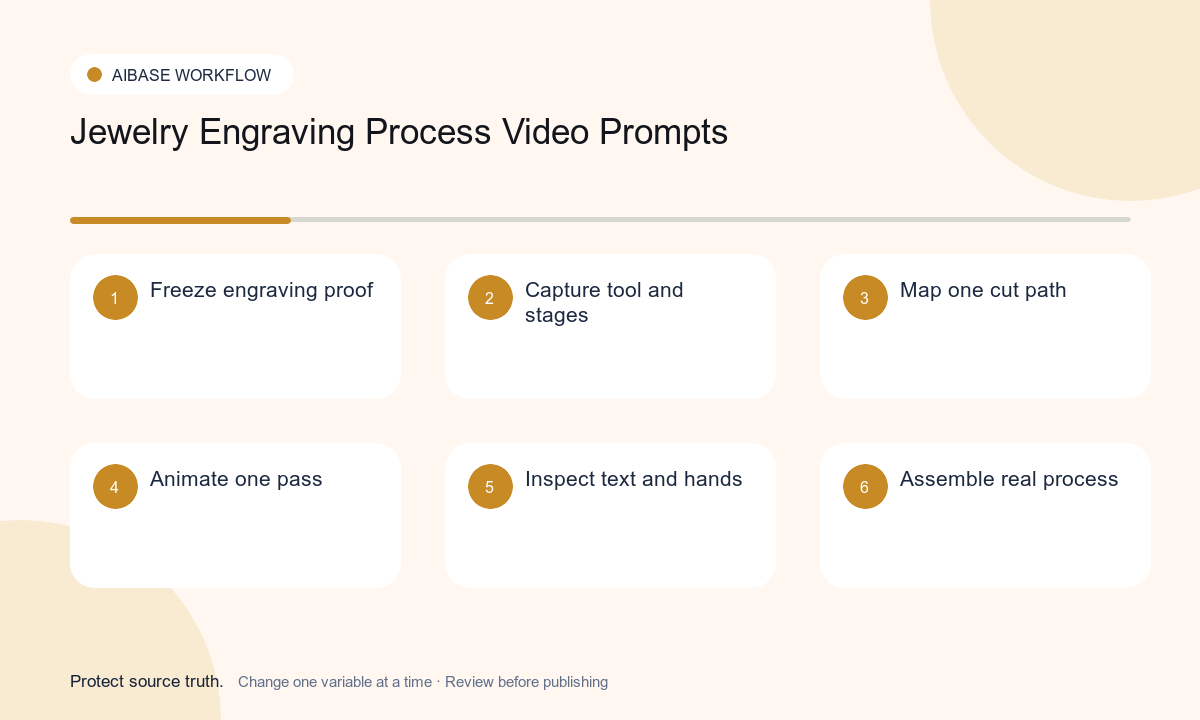
- Freeze the exact item, material, dimensions, design, spelling, typography, depth, finish, stage sequence, tool, operator, safety setup, customer consent, and usage rights.
- Capture authorized blank, guide, in-process, macro, tool-angle, hand-position, finished, cleanup, and inspection references with verified engraved content.
- Map the fixed workpiece, moving tool, supported hand, cut path, pressure cues, chip direction, reflections, and start and end frames for one action.
- Generate only one short documented pass with a stable camera; use real footage whenever the lettering, hallmark, signature, or customer artwork must remain exact.
- Inspect every frame for spelling drift, extra marks, changing jewelry geometry, duplicated tool, unstable fingers, floating chips, false sparks, stone damage, and unsafe technique.
- Assemble verified real process shots, artisan credit, material and personalization facts, safety context, disclosure, captions, music rights, care guidance, and CTA separately.
Example prompt variants
- Four-second macro of one approved hand-engraved leaf vein on a silver pendant: graver advances along the existing guide then lifts, preserve pendant edge, verified surrounding cuts, fingers, vise, chips, and locked camera.
- Three-second machine engraving pass across one documented straight border on a brass nameplate blank, preserve cutter, clamp, guide, depth, reflections, and no letters or numbers added.
- Five-second texture pass on the approved ring interior before any personal inscription, one short hatch motion only, preserve ring geometry, hallmark zone, tool angle, hand position, and bench light.
Quality checklist
- Item, material, geometry, stone, setting, engraving design, spelling, depth, finish, tool, stage, operator, and rights match approved sources.
- Tool angle, cut path, hand position, chip behavior, metal response, reflections, vise contact, and endpoint are physically and safely plausible.
- No letter, number, name, date, hallmark, signature, serial, logo, or customer artwork is invented, corrected, or mutated.
- The clip does not imply hand craftsmanship, precision, durability, material purity, personalization availability, or delivery timing beyond evidence.
- Source sequence, design proof, customer consent, prompts, frame review, artisan approval, edit, disclosure, and export remain traceable.
Mistakes to avoid
- Asking the model to engrave a complete name, date, monogram, hallmark, or signature from one blank frame.
- Animating several tool passes, hand repositioning, jewelry rotation, debris, and camera motion in one short clip.
- Showing the graver crossing fingers, a loose workpiece, false sparks, molten metal, or another unsafe and inaccurate technique.
- Presenting generated engraving motion as proof that a specific item was handmade, personalized, inspected, or completed for a customer.
Related AIBase pages
Practical next step
Open the most relevant AIBase generator, run one narrow prompt first, and save the best result before adding more constraints. The fastest way to improve output quality is to compare one variable at a time: subject, camera, background, lighting, then final polish.