
Veo 3.1 Pro Automotive Commercial Prompts for Controlled Car Shots
Plan controlled automotive commercial shots with Veo 3.1 Pro while protecting vehicle geometry, paint, lights, wheels, reflections, road safety, and edit continuity.
Quick answer
Build an automotive concept shot by shot. Anchor the exact body, wheel, light, glass, trim, paint, stance, and driving direction; request one safe vehicle action and one camera move; define the road, light, reflections, speed impression, and final frame; and treat generated output as concept material unless the vehicle and claims are independently verified.
Who this guide is for
Automotive creative teams, agencies, filmmakers, dealerships, and mobility brands developing controlled shot concepts, pitch frames, social loops, or previsualization with authorized vehicle references.
Recommended model
| Use case | Recommended model | Why |
|---|---|---|
| This workflow | Veo 3.1 Pro | The higher-quality video workflow is a reasonable choice for selected shots where deliberate camera movement, surface reflections, scene continuity, and a polished final frame matter more than bulk iteration. |
AIBase is an independent creative platform. Model names are shown only to identify supported underlying technologies and workflow choices.
Prompt template
Use the authorized vehicle reference as the exact design anchor. Keep the body silhouette, proportions, wheelbase, ride height, wheel design, tire size, paint color, glass, mirrors, grille, lights, trim, panel lines, badges, interior visibility, and vehicle count unchanged. Shot: [duration and ratio]. Vehicle action: [one safe action] at [controlled speed impression]. Camera: [one rig and move]. Road/environment: [closed controlled setting]. Light/reflections: [setup]. Start [frame] and end [stable edit point]. No redesign, wheel mutation, badge change, impossible steering, tire slide, public-road stunt, speed claim, autonomous-driving implication, extra vehicle, pedestrian, collision, readable plate, text, or watermark.
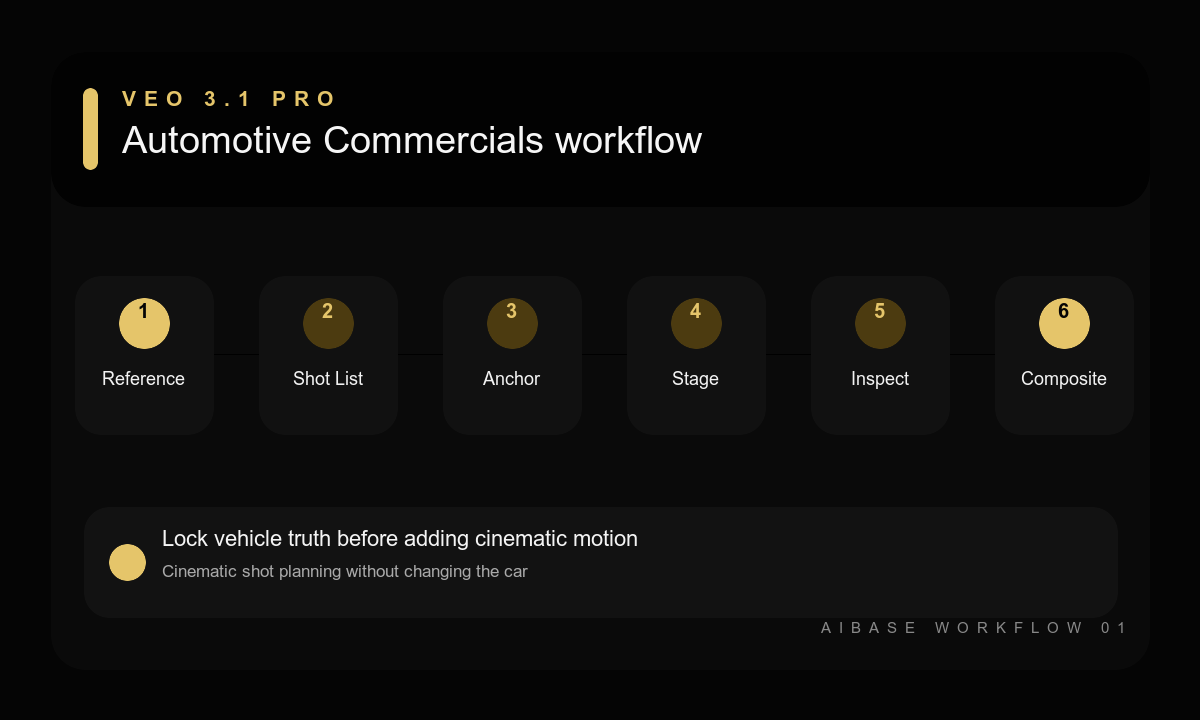
Step-by-step workflow
- Secure vehicle and location rights, verify the exact trim and approved claims, and decide whether the output is previsualization or publishable creative.
- Create a shot list with one vehicle action, camera move, light setup, duration, ratio, and edit point per shot.
- Prepare consistent authorized references for exterior angles, wheels, lights, badges, paint, and visible interior.
- Generate difficult shots separately and keep road behavior controlled, physically plausible, and clearly staged.
- Inspect frame by frame for body morphing, wheel changes, steering errors, light drift, reflection discontinuity, and unsafe implications.
- Composite approved logos, plates, disclaimers, sound, and verified specifications in post before brand, legal, and safety review.
Example prompt variants
- Eight-second 16:9 front three-quarter shot of the exact silver electric sedan moving slowly through a closed wet studio street; keep body, wheels, lights, glass, trim, and stance unchanged; low tracking camera, soft dawn reflections, stable side-profile ending.
- Six-second 9:16 detail shot of the exact blue coupe parked on a controlled stage; camera performs one slow arc around the front wheel and fender, keeping wheel spokes, tire, brake, paint, panel gap, and headlamp fixed; no vehicle movement.
- Eight-second 16:9 rear three-quarter shot of the exact compact SUV taking one gentle curve on a closed mountain-road set at safe speed; stabilized chase camera, golden-hour side light, no drift, traffic, pedestrian, or performance claim.
Quality checklist
- Body geometry, wheelbase, stance, wheels, lights, glass, trim, badges, paint, and interior remain consistent.
- Wheel rotation, steering angle, suspension, road contact, speed impression, shadows, and reflections are physically coherent.
- The camera uses one understandable move and the final frame cuts cleanly into the planned sequence.
- No unsafe public-road behavior, unverified performance, autonomous-driving claim, or misleading real-world context appears.
- Rights, exact trim, branding, specifications, sound, disclosures, and final safety review are complete.
Mistakes to avoid
- Relying on a model name alone instead of supplying authorized multi-angle vehicle references.
- Combining high-speed drift, drone dive, wheel macro, tunnel transition, and interior cut in one generation.
- Ignoring changing wheel spokes, lights, badges, mirrors, panel lines, and reflections between frames.
- Publishing previsualization as real driving footage or attaching performance claims the clip does not prove.
Related AIBase pages
- Create a polished car shot with Veo 3.1 Pro
- Follow the Veo 3.1 Pro cinematic workflow
- Prototype motion with Veo 3.1 Fast
- Compare Veo 3.1 Fast and Pro
Practical next step
Open the most relevant AIBase generator, run one narrow prompt first, and save the best result before adding more constraints. The fastest way to improve output quality is to compare one variable at a time: subject, camera, background, lighting, then final polish.