
Veo 3.1 Pro Cinematic Food Commercial Prompts
Design cinematic food commercial shots with Veo 3.1 Pro by controlling hero ingredients, one appetizing action, food physics, camera movement, light, continuity, and edit points.
Quick answer
Design one food behavior per shot: a pour, break, slice, steam rise, glaze pass, or ingredient fall. Protect the dish, portion, plating, packaging, and approved ingredients, then describe temperature, viscosity, gravity, light, and a single camera move so the motion feels appetizing rather than chaotic.
Who this guide is for
Restaurants, packaged-food teams, beverage brands, agencies, and creators building shot concepts, pitch films, menu-launch visuals, recipe intros, and previsualization for real food production.
Recommended model
| Use case | Recommended model | Why |
|---|---|---|
| This workflow | Veo 3.1 Pro for selected hero food shots | The higher-quality video route fits final concept shots where surface texture, controlled fluid or ingredient motion, and a deliberate camera move deserve more attention than bulk variation. |
AIBase is an independent creative platform. Model names are shown only to identify supported underlying technologies and workflow choices.
Prompt template
Create a [4/6/8]-second [aspect ratio] cinematic food commercial shot for [verified dish or product]. Keep [portion, plating, approved ingredients, packaging, label zone, vessel, surface, and set] consistent. Hero action: only [pour, break, slice, steam, drizzle, or ingredient fall]. Food behavior: [temperature], [viscosity or texture], [gravity path], [contact and splash limits]. Lighting: [motivated key and highlight]. Camera: [one move, framing, lens feel, speed]. End on [stable appetizing hero frame with copy space]. No extra ingredient, impossible stretch, endless pour, shape drift, dirty edge, changing label, utensil mutation, hand defect, cut, text, health claim, watermark, or exaggerated quantity.
Step-by-step workflow
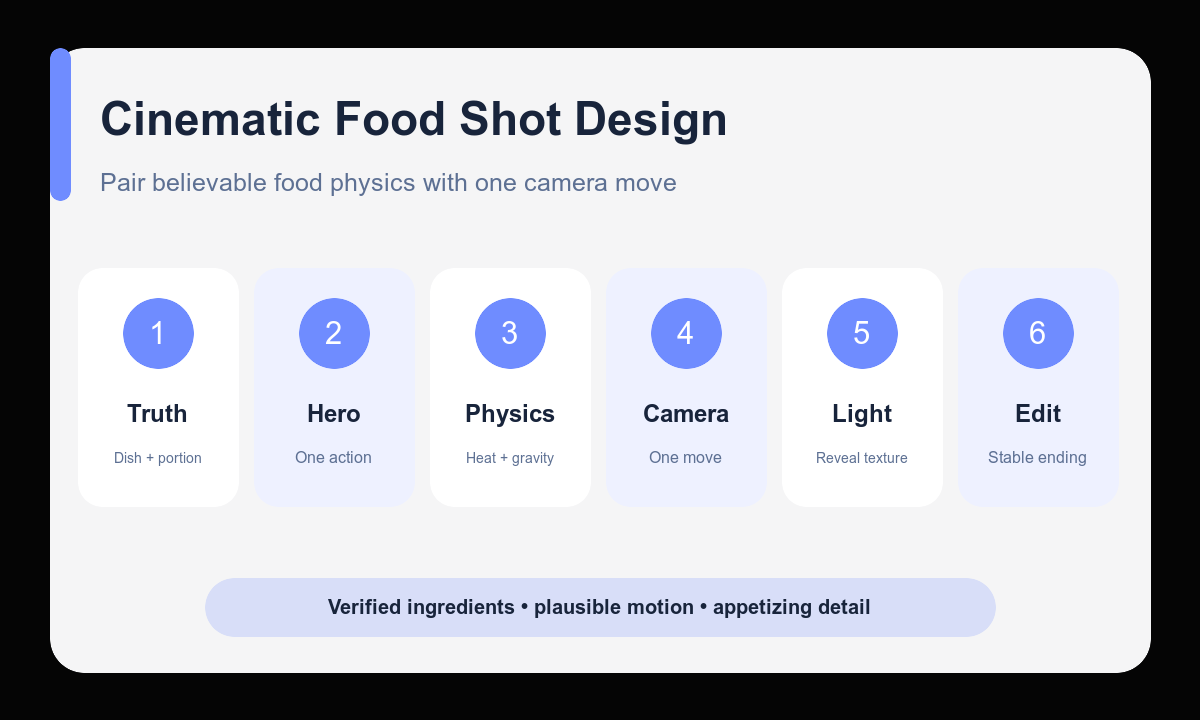
- Write the verified dish, portion, ingredients, packaging, and visual claim the shot may communicate.
- Select one hero action that can complete within the chosen duration.
- Describe the relevant physics: viscosity, heat, gravity, break texture, splash boundary, or crumb behavior.
- Pair one light design with one camera move that reveals texture without obscuring the food.
- Define a clean opening and stable hero ending that supports the next editorial shot.
- Review ingredients, portion, hygiene, hands, utensils, packaging, physics, and claims before final production use.
Example prompt variants
- Six-second 16:9 macro beverage shot, keep the exact clear glass, amber tea color, lemon slice, table, and approved garnish; one slow pour creates a restrained swirl and small realistic surface ripple; warm backlight, gentle push-in, stable ending.
- Four-second square pastry shot, keep the exact plated croissant size, layers, crumbs, and pale ceramic plate; one clean break reveals flaky interior with a few natural crumbs; locked macro camera, soft morning side light.
- Eight-second 9:16 noodle-bowl hero shot, keep the verified broth color, bowl, portion, toppings, and table; chopsticks lift one small bundle once, natural gravity and steam, slow vertical track, finish with the bowl fully visible.
Quality checklist
- Dish, portion, ingredients, garnish, packaging, vessel, and set remain verified and consistent.
- Liquid, steam, crumbs, stretch, heat, gravity, and contact behavior look physically plausible.
- Hands, utensils, food edges, reflections, and labels remain stable throughout the shot.
- The camera and light reveal texture while preserving an edit-ready hero ending.
- No nutrition, health, freshness, origin, quantity, or performance claim was invented.
Mistakes to avoid
- Combining a pour, slice, ingredient explosion, orbit, and lighting change in one shot.
- Using appetizing adjectives without specifying food behavior or camera design.
- Accepting endless liquid, rubbery texture, duplicated garnish, or changing portions.
- Publishing a concept before culinary, packaging, brand, and claims review.
Related AIBase pages
- Create a food shot with Veo 3.1 Pro
- Follow the Veo 3.1 Pro cinematic workflow
- Animate a food photo with Wan 2.7
Practical next step
Open the most relevant AIBase generator, run one narrow prompt first, and save the best result before adding more constraints. The fastest way to improve output quality is to compare one variable at a time: subject, camera, background, lighting, then final polish.