
Wan 2.7 Fountain Pen Cap Removal Product Video Prompts
Animate one controlled fountain-pen cap action while preserving exact threads, clip, trim, nib, finish, alignment, posting behavior, and product condition.
Quick answer
Start from a sharp authorized image and, ideally, a short reference showing whether the cap is threaded, snap-fit, magnetic, slip-fit, or retractable. Animate one verified twist, pull, click, or lift and stop at a documented endpoint. Do not reveal a nib, feed, section, threads, converter, cartridge, or inner cap that the references do not show; composite the approved product plate if those details matter.
Who this guide is for
Pen makers, stationery retailers, collectors, marketplaces, product photographers, and social editors creating tactile writing-instrument details from exact SKU references.
Recommended model
| Use case | Recommended model | Why |
|---|---|---|
| This workflow | Wan 2.7 image-to-video for one bounded cap movement | A short source-led mechanical action can highlight tactility while explicit locks protect reflective trim, small pen geometry, nib details, threads, and finish. |
AIBase is an independent creative platform. Model names are shown only to identify supported underlying technologies and workflow choices.
Prompt template
Animate the uploaded authorized fountain-pen photo as the exact first frame. Motion only: the existing [threaded / snap / magnetic / slip] cap performs the verified action [rotation direction and turns / pull distance] over [duration], revealing only the documented [section / nib / thread] area, then holds. Preserve exact SKU, barrel and cap diameter, taper, finial, clip, cap band, trim rings, seam, threads, section, nib and feed if visible, breather hole, imprint and logo zones, finish, pattern alignment, reflections, condition, shadow, camera, crop, and light. No hand unless present, extra turn, invented nib, changed clip, duplicated trim, warped barrel, scratch repair, ink, writing, text, sound, or watermark.
Step-by-step workflow
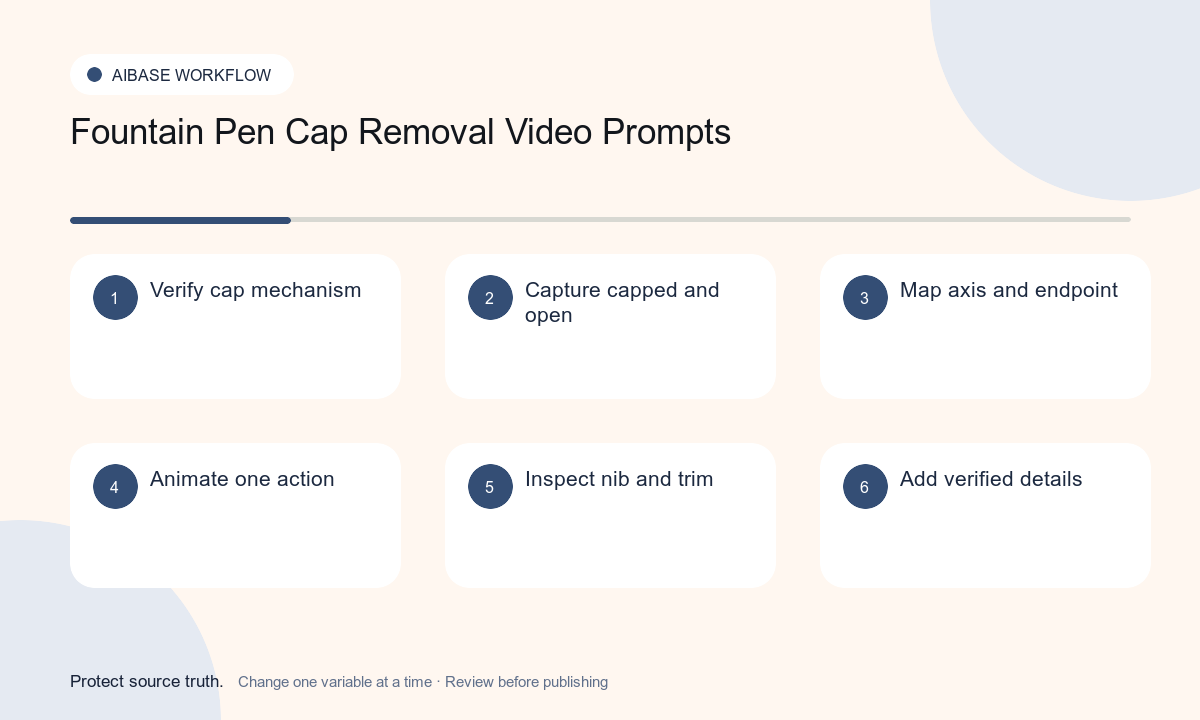
- Freeze SKU, cap mechanism, rotation direction and turns or pull travel, documented endpoint, nib and feed, trim, threads, posting behavior, included parts, condition, revision, rights, and claim limits.
- Capture approved capped, partial, uncapped, side, thread, inner-cap, section, nib, feed, clip, trim, finish, and scale references for the exact pen.
- Map fixed barrel, moving cap, axis, clearance, thread pitch cues, clip orientation, reflection anchors, reveal boundary, shadow, and stable endpoint.
- Generate a locked-camera macro with one cap action and stop before any undocumented interior or mechanism becomes visible.
- Inspect every frame for wrong rotation, changing cap length, duplicated clip or band, melted threads, nib mutation, warped barrel, reflection jumps, false ink, and impossible alignment.
- Composite approved details if needed and add verified mechanism, nib size, material, filling system, dimensions, care, price, availability, disclosure, and CTA separately.
Example prompt variants
- Four-second macro: the approved black threaded cap rotates counterclockwise exactly one documented turn and lifts five millimeters, preserve gold clip, cap band, barrel pattern, thread boundary, reflections, and locked camera.
- Three-second snap-cap pen: the existing cap moves straight outward one centimeter and stops before the nib is revealed, preserve seam, clip, trim ring, barrel finish, shadow, and no hand.
- Five-second magnetic-cap reference with documented nib: cap slides axially away and holds, preserve alignment, magnet seam, silver trim, exact nib engraving zone, feed, section, and no posting motion.
Quality checklist
- SKU, cap mechanism, dimensions, taper, finial, clip, bands, trim, threads, section, nib, feed, imprints, finish, condition, and included parts match approved sources.
- Axis, direction, turns or travel, clearance, thread behavior, reveal boundary, reflections, shadows, and endpoint are mechanically plausible.
- No extra clip, trim ring, thread, nib, feed, imprint, converter, cartridge, ink, writing, accessory, or repaired condition appears.
- The clip does not imply smoothness, seal quality, drying resistance, authenticity, nib performance, filling capacity, or durability without evidence.
- Truth sheet, source sequence, motion map, prompt, frame review, product approval, edit, disclosure, and export remain traceable.
Mistakes to avoid
- Prompting a generic uncapping action without specifying whether the exact cap twists, snaps, slides, or uses magnets.
- Revealing a nib, feed, thread, inner cap, converter, cartridge, or ink state that the source never documents.
- Adding a hand while also moving reflective trim, the cap, barrel, nib, shadows, and camera.
- Using a smooth generated motion as proof of cap seal, nib quality, craftsmanship, authenticity, durability, or writing performance.
Related AIBase pages
Practical next step
Open the most relevant AIBase generator, run one narrow prompt first, and save the best result before adding more constraints. The fastest way to improve output quality is to compare one variable at a time: subject, camera, background, lighting, then final polish.