
Wan 2.7 Jar Lid Opening Product Video Prompts for Stable Packaging Motion
Animate one controlled jar-opening action while preserving lid threads, seal state, label, fill level, hands, reflections, and packaging truth.
Quick answer
Choose an authorized frame where the exact jar, lid, hand contact, label, fill level, and seal state are clear. Ask Wan 2.7 for only a small counterclockwise turn or short lift that matches the real closure. Lock thread geometry, lid diameter, tamper band, label, contents, reflections, fingers, support hand, surface, and camera. Do not fabricate an intact seal breaking, a freshness cue, an easy-open claim, hidden contents, sound, or a complete removal when the source cannot support it.
Who this guide is for
Food, beauty, home-care, and packaging teams creating short product loops from approved jar photography.
Recommended model
| Use case | Recommended model | Why |
|---|---|---|
| This workflow | Wan 2.7 image-to-video for one low-amplitude packaging action | A source-led motion pass can add a tactile cue when the opening path is narrow and every packaging anchor is explicitly protected. |
AIBase is an independent creative platform. Model names are shown only to identify supported underlying technologies and workflow choices.
Prompt template
Animate the uploaded authorized jar photo as the exact first frame. Over [3-5 seconds], rotate the existing lid [one quarter-turn counterclockwise / through the documented opening direction] while the support hand keeps the jar fixed, then [stop before seal separation / lift only the already-loosened lid a few millimeters]. Preserve exact jar silhouette, neck, thread spacing, lid diameter and height, knurling, liner, tamper band and seal state, label text zone, color, contents, fill level, texture, condensation, reflections, hand count, fingers, grip, nails, surface, shadow, camera, crop, and light. No complete opening, new product exposure, spilling, steam, aroma cue, freshness claim, pop sound, easy-open claim, text, logo change, or watermark.
Step-by-step workflow
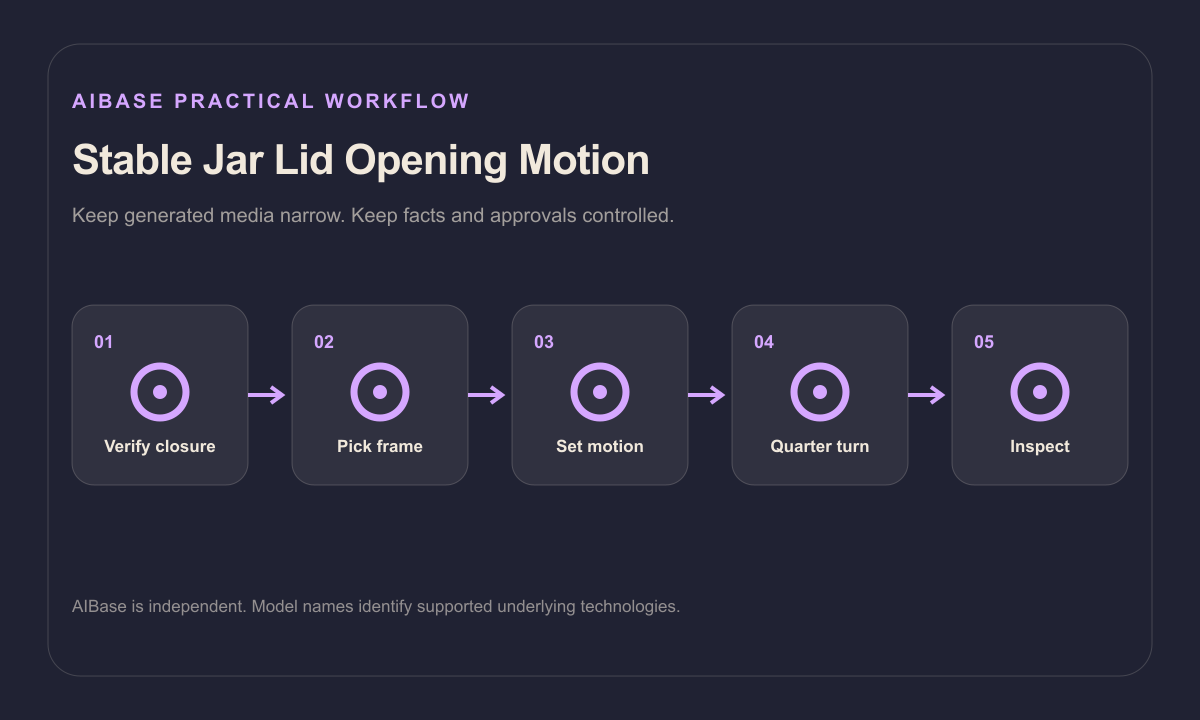
- Confirm SKU, closure type, thread direction, torque context, liner, tamper evidence, seal state, contents, fill level, packaging revision, and usage rights.
- Select a sharp source frame with visible lid-to-neck contact, stable support, clear hands, readable packaging zones, and a safe end state.
- Define the exact rotation direction, fraction of a turn, vertical travel, start, stop, and whether the approved source already shows a broken seal.
- Generate a locked-camera quarter-turn before attempting any lift, complete removal, or secondary product motion.
- Inspect every frame for thread drift, lid scaling, tamper-band changes, label mutation, contents movement, hand anatomy, grip contact, reflections, shadows, and stable ending.
- Add verified opening instructions, safety, storage, ingredients, fill quantity, claims, captions, sound, and CTA only in post-production.
Example prompt variants
- Four-second macro from the approved preserves jar photo: the metal lid turns counterclockwise one quarter-turn and stops, preserve tamper state, embossing, label, fruit level, both hands and locked camera.
- Three-second skincare jar clip: the already-loosened matte lid rotates slightly and lifts three millimeters, preserve liner, glass wall, cream surface, label zone, fingers, reflections and shadow; no product touch.
- Five-second home-care jar alternative with no opening: the closed approved jar remains fixed while one soft reflection moves across the lid, preserve closure, label, fill level and camera, no seal or performance cue.
Quality checklist
- Jar, neck, threads, lid, liner, tamper evidence, seal state, label, contents, fill level, color, and packaging revision match the source.
- Rotation direction, contact, torque implication, vertical travel, hand grip, gravity, reflections, and ending are physically coherent.
- No seal, freshness, aroma, ease-of-opening, safety, ingredient, fill, performance, or product-access claim is invented.
- Opening instructions, warnings, storage, ingredients, quantity, captions, audio, price, and CTA are verified editable layers.
- Source, closure facts, rights, prompt, output, frame review, approval, export, and correction trail remain traceable.
Mistakes to avoid
- Prompting the lid to pop off when the real closure uses threads, clips, vacuum, or a tamper band.
- Allowing the lid, jar neck, thread pitch, label, fill level, contents, seal, or fingers to morph during rotation.
- Treating generated steam, aroma, snap, resistance, or easy opening as product evidence.
- Animating a sealed pack as already open or breaking tamper evidence without an authorized, accurate source state.
Related AIBase pages
Practical next step
Open the most relevant AIBase generator, run one narrow prompt first, and save the best result before adding more constraints. The fastest way to improve output quality is to compare one variable at a time: subject, camera, background, lighting, then final polish.