
Nano Banana Pro Ceramic Tableware Campaign Prompts That Preserve Glaze Details
Build ceramic tableware campaign visuals with Nano Banana Pro while preserving exact silhouettes, glaze variation, set contents, scale, food safety claims, and catalog truth.
Quick answer
Treat the approved tableware set as immutable product data. Lock the count, profiles, rim thickness, foot rings, handles, glaze pattern, color range, scale, and known handmade variation before changing the table setting. Generate one composition at a time, keep food and props secondary, and add logos, dimensions, care guidance, and safety claims as verified layout layers rather than generated decoration.
Who this guide is for
Ceramic studios, home-goods brands, catalog teams, restaurants, retailers, and creative agencies preparing seasonal campaigns, collection pages, launch emails, or editorial product stories.
Recommended model
| Use case | Recommended model | Why |
|---|---|---|
| This workflow | Nano Banana Pro image-to-image for polished campaign scenes anchored to approved product references | A high-fidelity reference workflow is useful when subtle material, glaze, edge, scale, and set consistency matter more than rapid concept volume. |
AIBase is an independent creative platform. Model names are shown only to identify supported underlying technologies and workflow choices.
Prompt template
Use the approved reference images as the exact ceramic product source. Create a [campaign format] for [collection and audience] in [verified setting]. Preserve exact item count, bowl and plate profiles, rim thickness, foot rings, handle shapes, dimensions relative to each other, glaze color range, speckle or reactive pattern, matte or gloss finish, intentional handmade variation, and any approved maker mark. Composition [camera and crop], light [one setup], props [limited list], editable copy-safe zone [position]. Do not add, duplicate, stack impossibly, reshape, recolor, perfect away real variation, invent food-contact or durability claims, generate text, or obscure product edges.
Step-by-step workflow
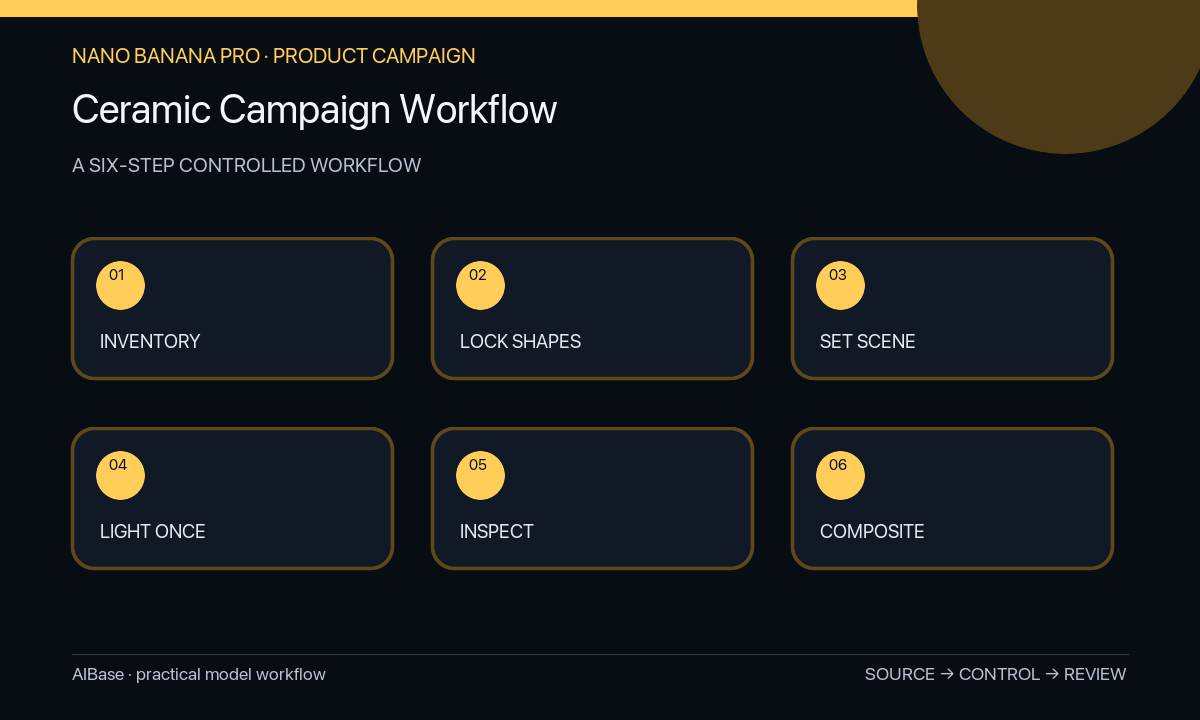
- Build an approved set inventory with SKU names, quantities, dimensions, profiles, glaze references, finish, acceptable handmade variation, care facts, claims, and image rights.
- Select reference angles that show every critical rim, base, handle, pattern, and scale relationship; do not rely on one front view for a multi-piece set.
- Choose one campaign job and draw the exact item arrangement, camera, support surfaces, prop limit, copy-safe zone, and crop family before prompting.
- Generate a first scene with product geometry and glaze protected, then vary only lighting, surface, or one prop while retaining the approved arrangement.
- Inspect count, nesting, contact, scale, ellipses, rim thickness, handles, foot rings, glaze continuity, reflections, chips, food realism, shadows, and crop at full resolution.
- Composite official marks, SKU names, dimensions, care notes, and substantiated claims as editable layers; keep the source-to-output approval trail with the catalog record.
Example prompt variants
- Approved four-piece stoneware place setting on pale oak, soft side daylight, three-quarter table view, preserve exact plate and bowl profiles, warm gray reactive glaze, rim variation, item count, scale, and foot rings; one linen napkin only, no text.
- Campaign close-up of the approved ceramic mug and saucer, quiet breakfast surface, backlight revealing verified glaze translucency and speckles, preserve handle opening, wall thickness, maker mark position, scale, and all intentional variation.
- Overhead collection image using the exact six approved pieces in the supplied arrangement, dark slate surface, restrained herbs at frame edge, balanced negative space right, no added dish, food claim, logo, copy, or glaze change.
Quality checklist
- Every SKU, quantity, silhouette, dimension relationship, rim, base, handle, mark, glaze, and finish matches approved references.
- Handmade variation remains plausible and truthful rather than copied identically or polished into industrial uniformity.
- Stacks, nesting, contact points, ellipses, shadows, reflections, food, and props obey physical scale and do not hide product details.
- No generated label, certification, food-safety, microwave, dishwasher, durability, origin, or sustainability claim appears.
- The campaign crop, text-safe area, official overlays, alt text, and source records are ready for each intended channel.
Mistakes to avoid
- Letting the model add or merge dishes and accidentally advertising a different set count.
- Using generic ceramic adjectives that replace a distinctive verified glaze with a cleaner fictional finish.
- Requesting an elaborate tablescape that obscures rim profiles, scale, handles, or the actual included pieces.
- Treating generated lifestyle context as evidence for food safety, handmade origin, durability, or care claims.
Related AIBase pages
- Open Nano Banana Pro
- Create product bundle photos
- Create lifestyle product concepts
- Plan product detail page images
Practical next step
Open the most relevant AIBase generator, run one narrow prompt first, and save the best result before adding more constraints. The fastest way to improve output quality is to compare one variable at a time: subject, camera, background, lighting, then final polish.