
Nano Banana Pro Cosmetics Campaign Visual Prompts for Premium Product Scenes
Create premium cosmetics campaign concepts with Nano Banana Pro prompts that control packaging truth, texture, swatches, skin, reflections, composition, and retouching review.
Quick answer
Start with a verified product-truth sheet and choose one campaign job: pack-shot hero, ingredient mood, texture study, shade story, or lifestyle context. Prompt the scene, camera, material behavior, surface, light, and negative space precisely, but composite approved packaging and add all copy or claims later.
Who this guide is for
Beauty founders, creative directors, ecommerce teams, photographers, retouchers, and agencies developing moodboards, preproduction directions, campaign key art, launch concepts, and channel adaptations.
Recommended model
| Use case | Recommended model | Why |
|---|---|---|
| This workflow | Nano Banana Pro | A high-fidelity generation or reference-led workflow is appropriate when the concept depends on distinct glass, metal, liquid, powder, cream, paper, and skin textures plus controlled studio lighting. |
AIBase is an independent creative platform. Model names are shown only to identify supported underlying technologies and workflow choices.
Prompt template
Create a premium cosmetics campaign concept for [verified product category and audience]. CAMPAIGN JOB: [pack-shot hero/texture/ingredient/shade/lifestyle]. PRODUCT TRUTH: [shape, size, material, color, cap, applicator, fill, approved label zone]. COMPOSITION: [camera, crop, placement, negative space]. SURFACE/PROPS: [limited list]. LIGHT: [one studio setup]. TEXTURES: [accurate behavior]. COLOR: [palette]. If a verified pack shot is supplied, preserve its exact geometry and use it as the product anchor. No readable label text, logo invention, claim, ingredient benefit, clinical result, certification, shade guarantee, extra applicator, distorted reflection, excessive skin smoothing, or watermark.
Step-by-step workflow
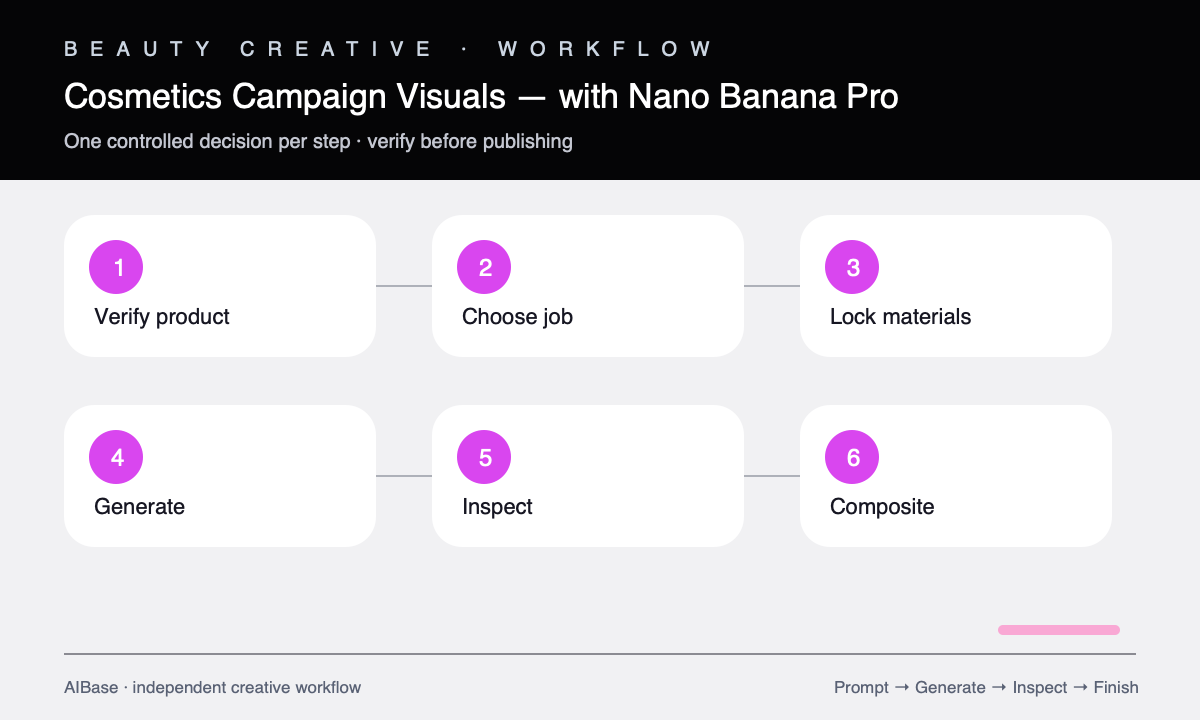
- Build a product-truth sheet from approved pack shots, dimensions, materials, finish, cap, applicator, fill color, shade status, and prohibited claims.
- Choose one visual objective and channel crop, then sketch where approved packaging, headline, proof, and CTA will be composited.
- Specify the material and lighting interaction, such as frosted glass diffusion, satin metal highlights, translucent gel, matte powder, or glossy balm.
- Generate background and scene concepts separately from exact label typography, regulated copy, color-critical swatches, and final skin retouching.
- Inspect packaging geometry, closures, applicators, reflections, liquid levels, texture physics, skin anatomy, nails, shade consistency, and crop safety.
- Composite verified product pixels, perform color-managed retouching, and route every visible claim, ingredient reference, swatch, and result through brand review.
Example prompt variants
- Skincare serum launch concept, one frosted glass dropper bottle centered on pale mineral stone, soft cool backlight through translucent water arcs, restrained silver-blue palette, clean upper copy zone, no label text or efficacy cue.
- Cream blush shade-story concept, three generic open compacts beside controlled pigment smears on warm ivory, overhead editorial macro, soft side light, distinct but unverified concept shades, no skin result or shade name.
- Lip balm campaign concept, one metallic tube and glossy translucent balm texture on smoked rose acrylic, low three-quarter camera, crisp rim light and soft reflection, negative space right, no logo or moisturizing claim.
Quality checklist
- Packaging proportions, closures, applicators, materials, fill level, label zone, and reflections are plausible and match approved references when supplied.
- Liquids, creams, powders, gels, droplets, and swatches behave like the named material rather than generic plastic or paint.
- Skin, lips, eyes, hands, and nails are anatomically plausible and do not imply an unverified before-and-after result.
- Copy space, product scale, focal hierarchy, and crop survive every intended placement.
- Final packaging, shades, claims, ingredients, certifications, typography, and results come from verified editable sources, not generated pixels.
Mistakes to avoid
- Prompting with luxury and glossy alone instead of defining product truth, material behavior, camera, surface, and light.
- Letting a concept image invent readable labels, ingredients, claims, certification marks, or clinical evidence.
- Treating generated swatches or skin results as color-accurate product proof.
- Using too many reflective props and losing the product silhouette in incoherent highlights.
Related AIBase pages
- Open Nano Banana Pro
- Create cosmetics texture videos
- Build product packaging mockups
- Create jewelry macro product photos
Practical next step
Open the most relevant AIBase generator, run one narrow prompt first, and save the best result before adding more constraints. The fastest way to improve output quality is to compare one variable at a time: subject, camera, background, lighting, then final polish.