
Seedance 2 Food Delivery Photo-to-Video Prompts
Animate a food delivery photo with Seedance 2 using bounded steam, packaging, handoff, and camera motion while preserving portions, toppings, labels, food safety, and offer truth.
Quick answer
Start with the actual delivered meal and packaging, then animate one appetite cue—subtle steam, a small lid reveal, sauce glint, or short camera push. Lock item count, portion size, toppings, doneness, container, seals, labels, utensils, shadows, and background; add price, timing, delivery claims, and platform UI later as editable overlays.
Who this guide is for
Restaurants, ghost kitchens, delivery marketplaces, franchise marketers, food photographers, and local agencies turning approved delivery packshots into menu reels and paid social clips.
Recommended model
| Use case | Recommended model | Why |
|---|---|---|
| This workflow | Seedance 2 image-to-video | A source-led clip can preserve the approved meal composition while adding one controlled motion cue and a short channel-ready camera move. |
AIBase is an independent creative platform. Model names are shown only to identify supported underlying technologies and workflow choices.
Prompt template
Animate the uploaded authorized food-delivery photo as the exact first frame. Preserve the exact dish count, portion, ingredients, toppings, garnish, sauce level, doneness, color, texture, container shape and material, lid, tamper seal, bag, napkin, utensil count, printed zones, crop, camera angle, table, background, lighting, reflections, and shadows. Motion: [one subtle cue such as steam rising naturally / lid opening a few centimeters / gentle camera push]. Duration [4-6 seconds], [aspect ratio], stable ending. Keep food and packaging physically supported and sanitary. Do not add, remove, refill, stir, bite, melt, stretch, duplicate, change ingredients, enlarge portions, improve doneness, open a sealed item unrealistically, invent hands, logos, readable text, price, delivery rider, app UI, or claim.
Step-by-step workflow
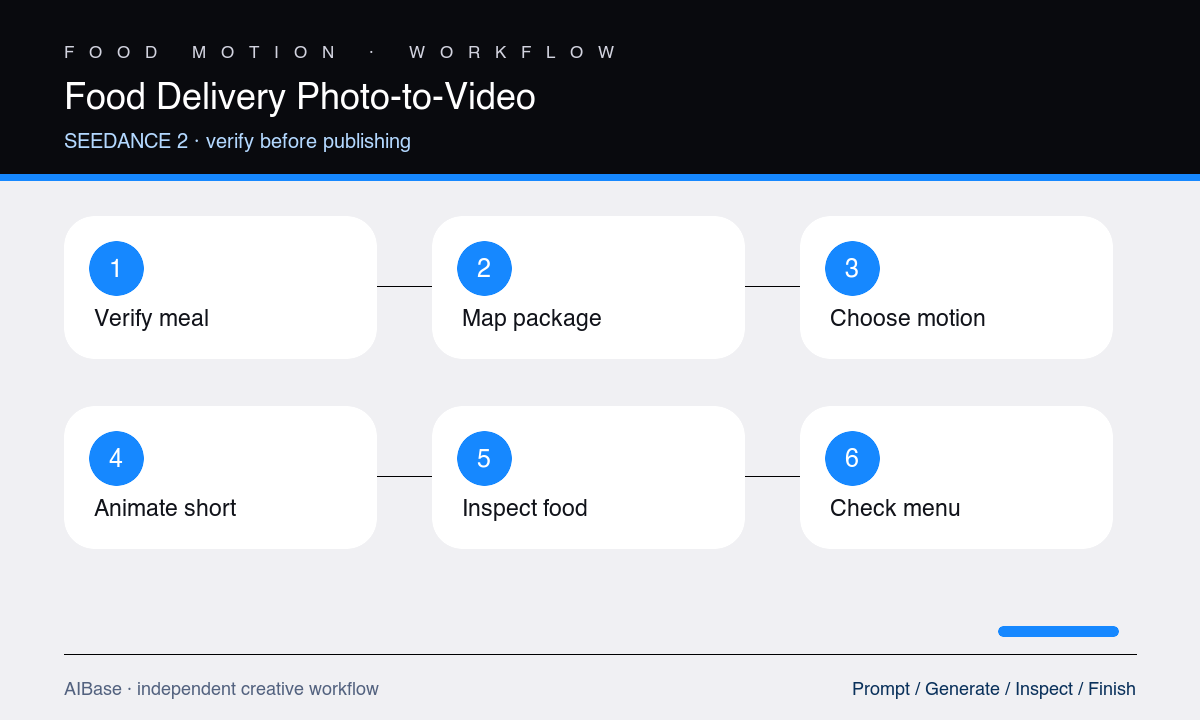
- Confirm the delivered configuration, current menu, portion standard, packaging version, allergen-sensitive ingredients, regional availability, offer terms, and rights to the source image.
- Inventory every visible dish, topping, sauce, seal, label zone, utensil, napkin, container, bag, reflection, shadow, and potential food-safety cue.
- Select one motion supported by the still and one camera move, keeping steam, lid, bag, handoff, or sauce behavior temporally simple.
- Write food and packaging invariants before motion, generate a short clip, and reject any version that changes portions, ingredients, doneness, or included items.
- Inspect frame by frame for steam origin, lid geometry, seal continuity, liquid behavior, label drift, duplicated garnish, utensil count, edges, shadows, and loop stability.
- Add verified price, delivery area, time, fees, CTA, logo, and disclosure outside generated pixels, then compare the post with the live menu and checkout.
Example prompt variants
- Five-second vertical clip of the approved noodle delivery bowl, locked three-quarter view with subtle steam only, preserve exact noodles, protein slices, scallions, broth level, bowl, lid beside it, chopsticks, table, light, and portion.
- Four-second square clip of the sealed burger meal, gentle camera push toward the open box, tiny paper-liner movement only, preserve burger layers, fries count impression, sauce cup, box print zones, tamper sticker, shadows, and no hand.
- Six-second vertical family-meal reveal with the approved bag stationary and one container lid lifting slightly then settling, preserve exact four containers, seals, dish contents, portions, labels, utensils, background, and no added food.
Quality checklist
- Dish count, portions, ingredients, toppings, garnish, sauce, doneness, color, and texture remain faithful to the actual delivered menu item.
- Containers, lids, seals, bags, labels, utensils, napkins, included sides, and repeated counts remain stable and physically plausible.
- Steam, packaging, camera, and any hand motion have clear cause, restrained speed, stable edges, coherent shadows, and a clean ending.
- No generated price, timing, fee, discount, nutrition, popularity, delivery, freshness, portion, or ingredient claim appears in the video.
- The final overlay, caption, destination menu, availability, allergen information, offer terms, and disclosure agree at publish time.
Mistakes to avoid
- Asking for steam, sauce pour, lid opening, handoff, camera orbit, ingredient fall, and logo reveal in one short source-led clip.
- Allowing the animation to add protein, garnish, sides, sauce, packaging, or a larger portion than customers receive.
- Animating a sealed or hot container in a physically unsafe way or introducing hands without hygiene and consent planning.
- Rendering price, delivery time, app interface, discount, or availability into frames that cannot be updated when operations change.
Related AIBase pages
- Open Seedance image-to-video
- Animate restaurant menu photos
- Animate a beverage pour
- Create short social ad storyboards
Practical next step
Open the most relevant AIBase generator, run one narrow prompt first, and save the best result before adding more constraints. The fastest way to improve output quality is to compare one variable at a time: subject, camera, background, lighting, then final polish.