
Veo 3.1 Pro Wildlife Rehabilitation Brand Film Prompts
Plan respectful wildlife-rehabilitation brand films with Veo 3.1 Pro using real rescue evidence and generated atmosphere only—never fabricated animals or outcomes.
Quick answer
Let verified rescue footage carry the story. Use Veo 3.1 Pro only for text-free nature atmosphere—light through native plants, water movement, sky, habitat texture, or abstract transitions. Do not generate rescued animals, medical treatment, releases, rehabilitators, species behavior, outcomes, permits, or donor impact. Disclose AI-assisted visuals when viewers could mistake them for rescue evidence.
Who this guide is for
Wildlife rehabilitation centers, conservation nonprofits, volunteer media teams, and agency partners producing careful brand films, volunteer recruitment, or donation campaigns.
Recommended model
| Use case | Recommended model | Why |
|---|---|---|
| This workflow | Veo 3.1 Pro | It can create cinematic atmospheric plates and transitions, but factual rescue evidence, animal welfare, medical accuracy, and legal consent require real authorized footage. |
AIBase is an independent creative platform. Model names are shown only to identify supported underlying technologies and workflow choices.
Prompt template
Create a [4-8 second] text-free cinematic nature atmosphere plate for a wildlife-rehabilitation brand film. Purpose: [habitat mood / transition / abstract care metaphor]. Subject: [native plant light / clean water / sky / protected habitat texture]. Camera: [locked or slow move]. Preserve a calm [caption-safe] area. No animal, rescue, treatment, release, rehabber, person, medical device, enclosure, species behavior, outcome statistic, permit, location, donation claim, word, number, logo, or watermark.
Step-by-step workflow
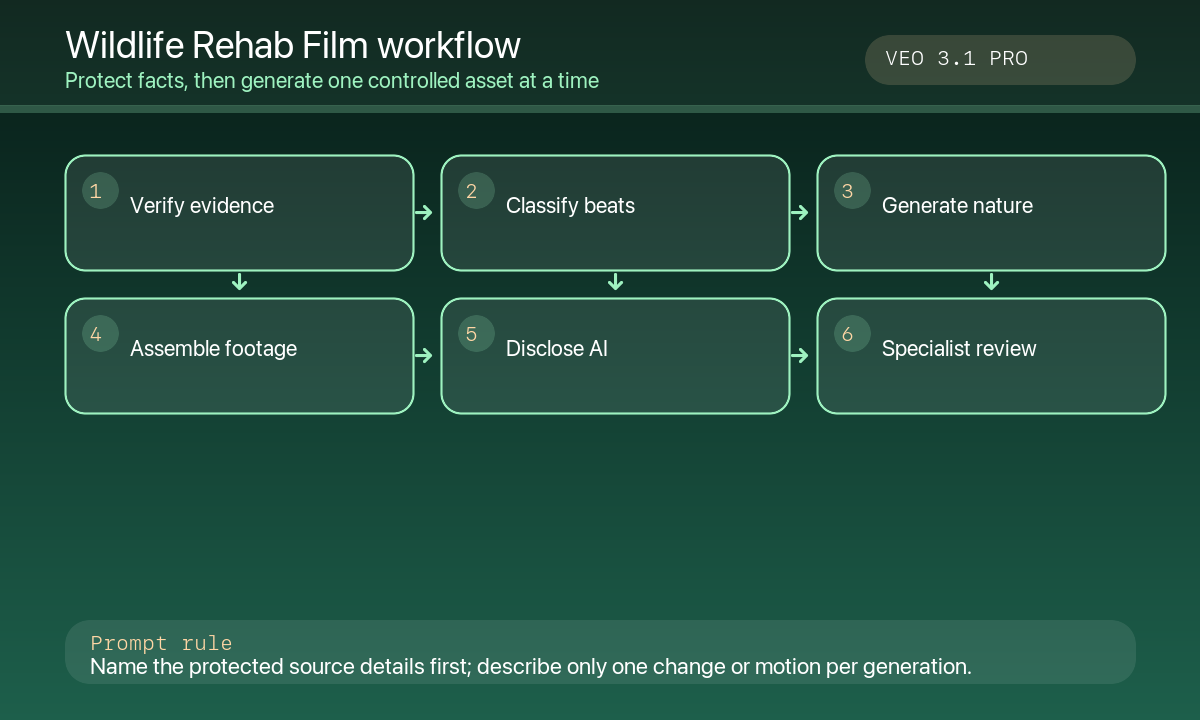
- Build an evidence log: species, dates, locations, permits, photographer rights, rehabber releases, medical facts, outcomes, and prohibited claims.
- Separate the film into real rescue footage, verified impact evidence, interviews, native habitat footage, and synthetic atmosphere.
- Generate only abstract or habitat-texture plates; use no synthetic animals, handling, treatment, or release moments.
- Edit the narrative around animal welfare and accuracy, avoiding distressing or misleading sequence order.
- Composite captions, impact figures, legal disclosures, accessibility, and donation flow as editable layers.
- Review with a rehabilitation or species specialist, then disclose AI-assisted atmosphere wherever evidence could be misread.
Example prompt variants
- Five-second dawn atmosphere: soft light moves through native grasses, slow lateral camera, no animal, enclosure, rescue cue, location, or text.
- Four-second care metaphor: clean water flows over smooth river stones in calm ambient light; no injured animal, treatment, species, medical claim, or people.
- Six-minute film transition plate: quiet sky gradient above a blurred protected habitat edge with lower caption-safe area; no rescue, release, statistic, logo, or words.
Quality checklist
- Every animal, treatment, release, location, permit, outcome, and impact claim is supported by authorized real footage or records.
- No generated animal, rehabber, medical procedure, enclosure, donor result, or species behavior is presented as fact.
- Story order protects animal welfare and avoids sensationalizing distress.
- AI-assisted atmosphere is disclosed where viewers could infer rescue evidence.
- Captions, impact data, legal disclosures, donation flow, accessibility, and consent records are reviewed and traceable.
Mistakes to avoid
- Generating an injured or released animal to manufacture emotional proof.
- Inventing a release site, rescue count, survival rate, volunteer role, or veterinary outcome.
- Using a synthetic habitat as evidence of local conservation impact.
- Ignoring permits, animal-welfare guidance, media consent, and supporter privacy.
Related AIBase pages
Practical next step
Open the most relevant AIBase generator, run one narrow prompt first, and save the best result before adding more constraints. The fastest way to improve output quality is to compare one variable at a time: subject, camera, background, lighting, then final polish.