
Seedance 2 Flower Bouquet Process Video Prompts for Florist Social Clips
Turn authorized bouquet process photos into short Seedance 2 clips while preserving flower varieties, stem counts, hand technique, arrangement sequence, and availability claims.
Quick answer
Animate one verified arranging action per clip: rotate one stem into position, tighten one hand-tie, fold one paper edge, or turn the completed bouquet slightly. Start from a clear authorized process frame, lock flower varieties, colors, approximate stem counts, tools, hands, wrapping, and workbench, and never let the model invent seasonal availability, sourcing, freshness, fragrance, price, or delivery proof.
Who this guide is for
Florists, flower farms, wedding studios, workshop teachers, craft marketplaces, and social teams creating short process clips from real bouquet-making photographs.
Recommended model
| Use case | Recommended model | Why |
|---|---|---|
| This workflow | Seedance 2 image-to-video for one source-led floristry action per shot | Short image-led motion can add continuity to a real process frame when the prompt limits hand, stem, paper, and camera movement to one documented action. |
AIBase is an independent creative platform. Model names are shown only to identify supported underlying technologies and workflow choices.
Prompt template
Animate the uploaded authorized bouquet-process photo as the exact first frame. Verified step: [specific action]. Preserve exact visible flower varieties and colors, approximate stem count, bloom scale and openness, greenery, stem lengths, hand identity and anatomy, grip, tool, ribbon, paper, vessel, workbench, background, light, camera, crop, and all already completed arrangement structure. Motion: [one stem rotates gently into the existing gap / one paper flap folds along the visible crease / bouquet turns slightly in the existing grip] over [3-5 seconds], camera [locked / one slow push], stable final frame. No new or disappearing flower, blooming, wilting, color change, impossible stem bend, hand mutation, cut without tool contact, floating material, different wrapper, text, logo, price, freshness, sourcing, fragrance, delivery, or seasonal claim.
Step-by-step workflow
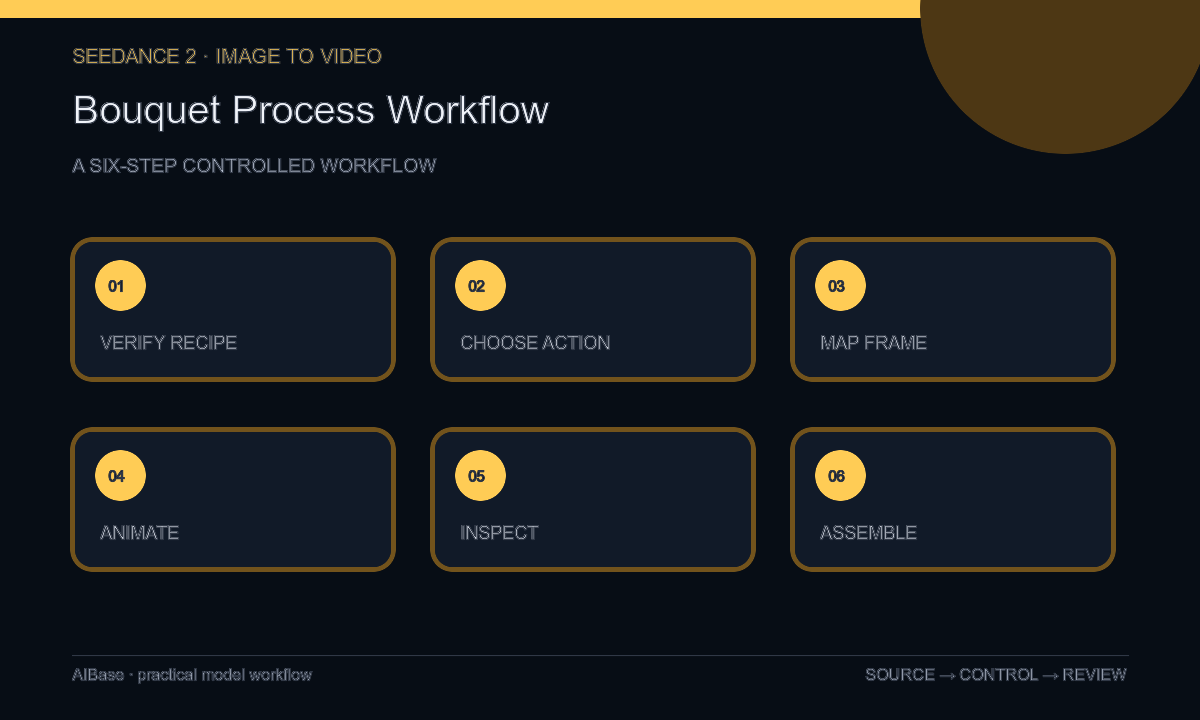
- Verify the real bouquet recipe, substitutions, source-image rights, florist or hand consent, documented process order, tool use, wrapping materials, and which availability or origin claims are approved.
- Break the process into honest single-action beats—condition, select, place, rotate, tie, trim, wrap, or present—and choose only frames that clearly support the next movement.
- Inventory flowers, colors, approximate counts, bloom states, greenery, stems, hands, tools, ribbons, paper folds, vessel, workbench, camera, and protected completed structure.
- Generate three-to-five-second clips with one small action and conservative camera movement; use separate clips for placing, tying, trimming, wrapping, and reveal.
- Inspect every frame for flower count, species appearance, color, bloom size, stem continuity, hand anatomy, grip, tool contact, paper physics, ribbon, shadows, and final arrangement.
- Assemble only verified steps, add real captions, florist credit, product details, price, availability, care guidance, music rights, and disclosure in post, then review before publishing.
Example prompt variants
- Four-second locked close-up: the florist rotates the one visible pale rose stem a few degrees into the existing center gap, preserve all blooms, eucalyptus, stem count impression, left-hand grip, scissors on table, paper, light, and no new flower.
- Three-second wrapping shot: one kraft-paper flap folds inward along the visible crease while the bouquet and supporting hand remain stable, preserve flower colors, ribbon, paper texture, table, shadows, and no automatic tie or cut.
- Five-second completed bouquet reveal: the existing hands turn the arrangement fifteen degrees and stop, preserve exact blooms, greenery, shape, wrapper, ribbon, hand anatomy, neutral wall, and no blooming, falling petal, or camera orbit.
Quality checklist
- Visible flower varieties, colors, approximate counts, bloom states, greenery, stem lengths, bouquet shape, wrapper, ribbon, and tools remain source-faithful.
- Hands, grips, tool contact, stem movement, paper folds, ribbon tension, gravity, collisions, shadows, and final resting state are physically coherent.
- The clip shows one documented process action and does not invent a cut, tie, placement, recipe, substitution, or finished arrangement.
- No unsupported freshness, fragrance, local origin, sustainability, seasonal availability, price, delivery, or care claim is implied.
- Recipe, source, consent, prompts, frame review, edit, credits, claims, disclosure, export, and destination remain traceable.
Mistakes to avoid
- Asking one clip to select, trim, arrange, tie, wrap, and reveal the bouquet, causing flowers and hands to multiply or change.
- Ignoring flower count and allowing blooms, greenery, stems, ribbon, or wrapping paper to appear and disappear.
- Animating a cut or tie without clear tool contact and physically plausible hand movement.
- Using generated abundance, bloom condition, farm imagery, or speed as evidence of availability, freshness, sourcing, craftsmanship, or fulfillment.
Related AIBase pages
- Open Seedance 2
- Animate handmade product processes
- Create candle-making process clips
- Compare source-led social video models
Practical next step
Open the most relevant AIBase generator, run one narrow prompt first, and save the best result before adding more constraints. The fastest way to improve output quality is to compare one variable at a time: subject, camera, background, lighting, then final polish.