
Seedance 2.0 Pottery Process Video Prompts from Finished Product Photos
Turn an authorized pottery product photo into a restrained studio-process clip without inventing provenance, handcraft claims, maker identity, or impossible clay motion.
Quick answer
A finished mug or vase photo cannot prove how that exact piece was made. Use it for a truthful product-detail shot or a clearly labeled illustrative studio moment: one small hand action, one camera move, and locked form, glaze, marks, and background. Use real process footage whenever provenance, handmade technique, or the maker is part of the claim.
Who this guide is for
Ceramic artists, studio shops, craft marketplaces, museum stores, workshop promoters, and social teams creating short product stories from authorized images while protecting maker attribution and process truth.
Recommended model
| Use case | Recommended model | Why |
|---|---|---|
| This workflow | Seedance 2.0 image-to-video | Image-conditioned motion can add subtle studio atmosphere to a finished-product reference, provided the shot does not pretend to document the actual making of that item. |
AIBase is an independent creative platform. Model names are shown only to identify supported underlying technologies and workflow choices.
Prompt template
Use the uploaded authorized pottery photo as the exact first-frame and product reference. Preserve the vessel's silhouette, proportions, rim, foot, handle, wall thickness where visible, glaze color, glaze breaks, speckles, brush marks, carving, maker's mark, imperfections, count, placement, table, tools, backdrop, crop, light, shadows, and camera height. Create a clearly illustrative [4-6]-second studio moment: [one truthful low-amplitude action, such as a hand rotating the finished piece a few degrees / a soft cloth wiping the table beside it / daylight shifting gently]. Camera: [locked or one slow move]. Keep the pottery solid and finished. No clay forming from nothing, wheel throwing, firing, glazing, carving, maker face, studio identity, extra hand, changed vessel, altered mark, new crack, food use, provenance claim, text, cut, transition, watermark, or sound.
Step-by-step workflow
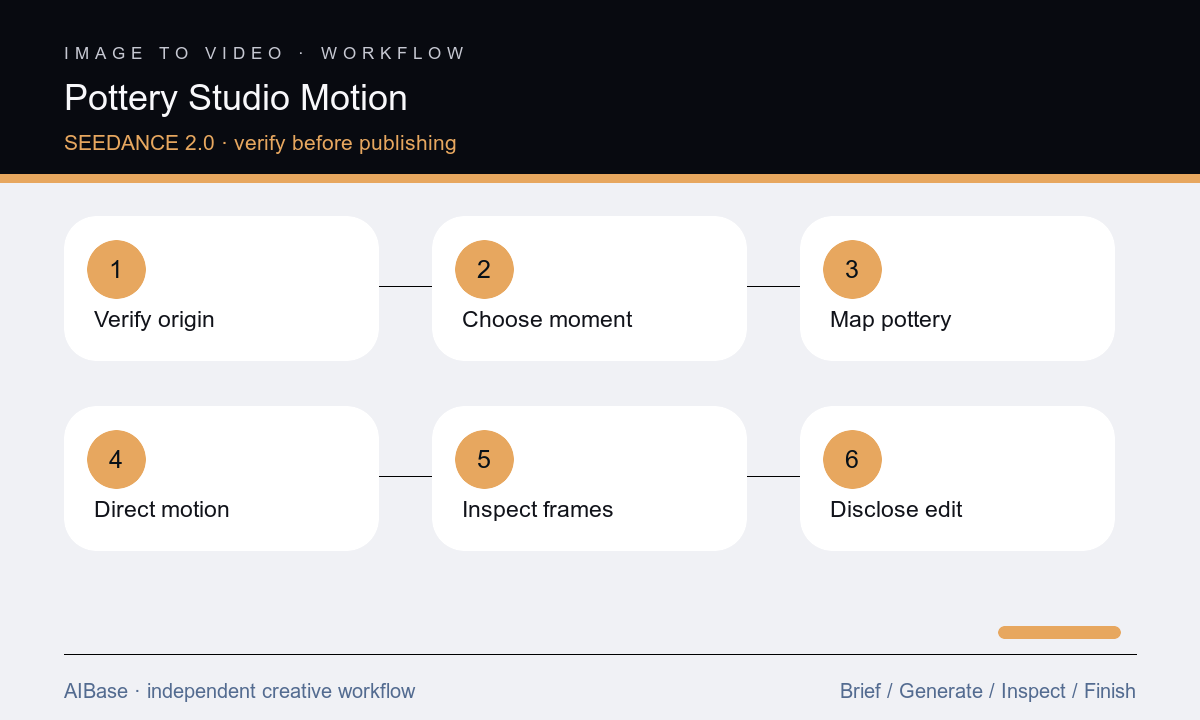
- Confirm image rights, maker permission, actual materials and techniques, provenance, studio identity, product availability, and which process statements can be substantiated.
- Choose whether the asset is a real process document, an illustrative studio mood shot, or a finished-product detail; use real footage for documentary claims.
- Map the vessel’s silhouette, handle, rim, foot, glaze, marks, imperfections, scale, contact shadow, props, and any hands or tools visible in the source.
- Direct one low-amplitude action and one camera behavior, locking the finished object and avoiding any transformation that suggests a fabricated making sequence.
- Generate a short plate and inspect every frame for pottery morphing, handle drift, glaze crawling, mark changes, hand errors, floating contact, tool collision, and camera jumps.
- Edit with truthful captioning and audio, disclose illustrative AI motion when needed, link to verified process information, and preserve a correction or removal path.
Example prompt variants
- Five-second locked shot of the exact approved speckled mug on a studio table, a permitted hand gently rotates it ten degrees and leaves frame, preserve handle, rim, glaze breaks, maker mark, shadow, tools, and no making-process claim.
- Four-second slow lateral move past the exact approved blue vase, finished product remains still, subtle window-light shift only, preserve silhouette, glaze gradient, foot, small firing marks, table dust, background, and scale.
- Six-second overhead product-detail plate of three authorized ceramic bowls, camera locked, one soft cloth moves beside but never touches them, preserve count, nesting order, rim irregularities, brush marks, shadows, and no invented hands or tools.
Quality checklist
- The vessel remains identical in silhouette, scale, rim, foot, handle, glaze, decoration, maker mark, imperfections, count, placement, and contact shadow.
- Motion is physically plausible and restrained with no liquid clay transformation, impossible wheel sequence, firing effect, glaze change, floating object, or hand collision.
- Maker identity, origin, materials, handcraft status, technique, production time, edition, sustainability, and availability match documented facts.
- The caption distinguishes real footage from illustrative AI-added motion whenever viewers could mistake the clip for process documentation.
- Rights, source photo, maker approval, prompt, output, edit, soundtrack, disclosure, destination, and correction contact are recorded.
Mistakes to avoid
- Animating a finished vessel backward into wet clay and presenting the sequence as how the exact item was made.
- Adding an anonymous pair of hands or a recognizable maker without consent and allowing fingers to merge with the pottery.
- Letting glaze color, handle shape, maker mark, rim irregularity, or object count drift because the overall studio mood looks attractive.
- Using invented process visuals to support handmade, local, sustainable, or traditional-technique claims that have not been verified.
Related AIBase pages
- Open Seedance 2.0
- Animate handmade product processes
- Create fashion lookbook motion
- Compare product image-to-video models
Practical next step
Open the most relevant AIBase generator, run one narrow prompt first, and save the best result before adding more constraints. The fastest way to improve output quality is to compare one variable at a time: subject, camera, background, lighting, then final polish.