
Veo 3.1 Pro Independent Bookstore Brand Film Prompts
Plan an independent bookstore brand film with Veo 3.1 Pro while protecting real inventory, authors, covers, customers, staff, events, location, history, and community claims.
Quick answer
Film the actual storefront, shelves, books, staff, customers, events, neighborhood, and archival history whenever those details identify or prove the bookstore. Use Veo 3.1 Pro only for cinematic text-free atmosphere such as abstract paper, light, or binding-material plates that do not copy a cover or imply real inventory. Keep author names, titles, event facts, recommendations, awards, dates, prices, and community claims tied to approved sources and editable graphics.
Who this guide is for
Independent bookstores, literary nonprofits, retail marketers, publishers collaborating with shops, and agencies creating a manifesto film, anniversary piece, website hero, seasonal trailer, or membership campaign.
Recommended model
| Use case | Recommended model | Why |
|---|---|---|
| This workflow | Veo 3.1 Pro for selected cinematic atmosphere, with real footage for the bookstore and its community | A quality-oriented model can create deliberate material and light studies, while source routing keeps books, people, place, and history authentic. |
AIBase is an independent creative platform. Model names are shown only to identify supported underlying technologies and workflow choices.
Prompt template
Create a cinematic [4-7 second] text-free atmospheric plate for an independent bookstore brand film. Purpose: [reading mood / chapter transition / material detail], not a depiction of the real shop, inventory, author, event, or customer. Subject: [generic unprinted paper edges / abstract binding cloth / nonliteral pool of reading light], one motion [specific], camera [one move], lens and crop [specific], palette [specific], stable final frame. Do not show or imitate a book cover, title, author, publisher mark, quotation, manuscript, recognizable illustration, store interior, facade, shelf inventory, person, event, neighborhood, award, bestseller status, recommendation, price, logo, word, letter, number, or watermark.
Step-by-step workflow
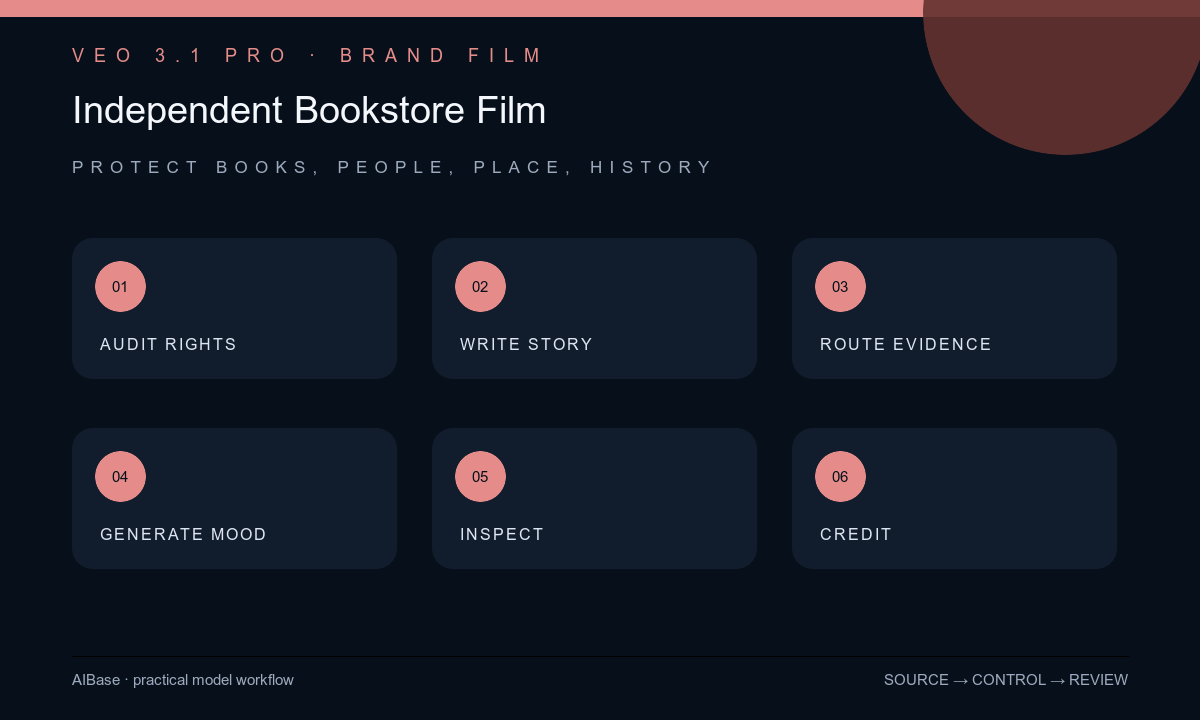
- Create a rights and facts ledger for the storefront, interiors, books and covers, authors, publishers, staff, customers, minors, events, archival media, neighborhood, music, quotations, awards, dates, and usage windows.
- Write the film around verified bookstore values and experiences, then label each shot as current evidence, authorized archive, interview, controlled graphic, licensed media, or synthetic atmosphere.
- Route the actual store, shelves, inventory, people, events, recommendations, history, and location to authorized capture; reserve generation for abstract paper, light, or material transitions.
- Generate one physical motion per plate with generic unprinted materials, no readable marks, and no visual resemblance to a real cover, author identity, shop interior, or event.
- Inspect every frame for accidental lettering, cover-like composition, invented inventory, impossible paper behavior, hands or faces, copyrighted illustration resemblance, and misleading adjacency beside narration.
- Add exact credits, titles, event facts, captions, disclosures, and CTA in post; archive the ledger, sources, prompts, approvals, edit, publication scope, and correction path.
Example prompt variants
- Five-second macro of generic unprinted deckled paper edges as one warm light moves slowly across them, shallow camera slide, no page text, cover, hand, shelf, logo, title, author, or store identity.
- Four-second abstract chapter transition, one blank cream card turns gently against deep green binding cloth, locked close composition, no book object, lettering, illustration, person, publisher mark, price, or quotation.
- Six-second nonliteral reading-light plate, a soft oval of amber light narrows over a neutral paper-texture plane, slow overhead camera, stable final frame, no readable page, furniture, room, book, person, or claim.
Quality checklist
- Every real store image, book, cover, author, staff member, customer, event, archive, quotation, neighborhood detail, award, and date is authorized and accurate.
- Synthetic plates remain abstract, unprinted, non-identifiable, and clearly separate from inventory, documentary, recommendation, or historical evidence.
- Narration and editing do not imply a generated title is stocked, an author appeared, an event occurred, a customer endorsed, or a community outcome was measured.
- Paper, cloth, light, camera, pacing, captions, credits, audio, disclosure, contrast, and final-frame stability pass creative and accessibility review.
- Rights ledger, sources, prompts, outputs, edit, approvals, publication scope, expiration, and correction path remain traceable.
Mistakes to avoid
- Generating recognizable book covers, titles, author names, quotations, illustrations, or shelf inventory as atmospheric decoration.
- Using unapproved customer, child, staff, author, event, archive, or neighborhood footage because the film is promotional.
- Cutting abstract paper footage beside claims about selection, sales, literacy impact, community reach, history, or sustainability and implying proof.
- Omitting credits, permissions, conceptual disclosure, event expiration, or a correction path for a film built around cultural works and real people.
Related AIBase pages
- Open Veo 3.1 Pro
- Create museum exhibition trailers
- Create architecture studio brand films
- Create specialty coffee brand films
Practical next step
Open the most relevant AIBase generator, run one narrow prompt first, and save the best result before adding more constraints. The fastest way to improve output quality is to compare one variable at a time: subject, camera, background, lighting, then final polish.