
HappyHorse Vintage Portrait Animation Prompts for Subtle, Respectful Motion
Animate authorized vintage portraits with HappyHorse prompts that preserve identity, age, period details, pose, restoration status, consent, and subtle motion.
Quick answer
Confirm that you have the right and appropriate context to animate the portrait, then make only conservative repairs before motion. Protect identity, apparent age, expression, pose, clothing, period details, crop, and photographic texture, and request one subtle action such as a blink or breath with a locked camera.
Who this guide is for
Families, archivists, educators, museum teams, documentary editors, and creators making private keepsakes or clearly labeled historical storytelling from authorized vintage portraits.
Recommended model
| Use case | Recommended model | Why |
|---|---|---|
| This workflow | HappyHorse image-to-video | Its portrait-oriented image-to-video workflow is a practical option for testing restrained motion when the source image, identity, and historical context must remain the visual anchor. |
AIBase is an independent creative platform. Model names are shown only to identify supported underlying technologies and workflow choices.
Prompt template
Use the uploaded authorized vintage portrait as the exact identity, age, pose, composition, and period reference. Preserve face shape, features, expression, gaze, hairstyle, body proportions, hands, clothing, jewelry, insignia, objects, backdrop, crop, black-and-white or sepia tonality, grain, and restoration level. Animate only [one natural blink/subtle breathing/tiny gaze shift] for [duration], camera locked, no speech, clean return to the source pose. No smile change, age change, beautification, head turn, lip movement, new gesture, modern detail, colorization, invented background, text, or watermark.
Step-by-step workflow
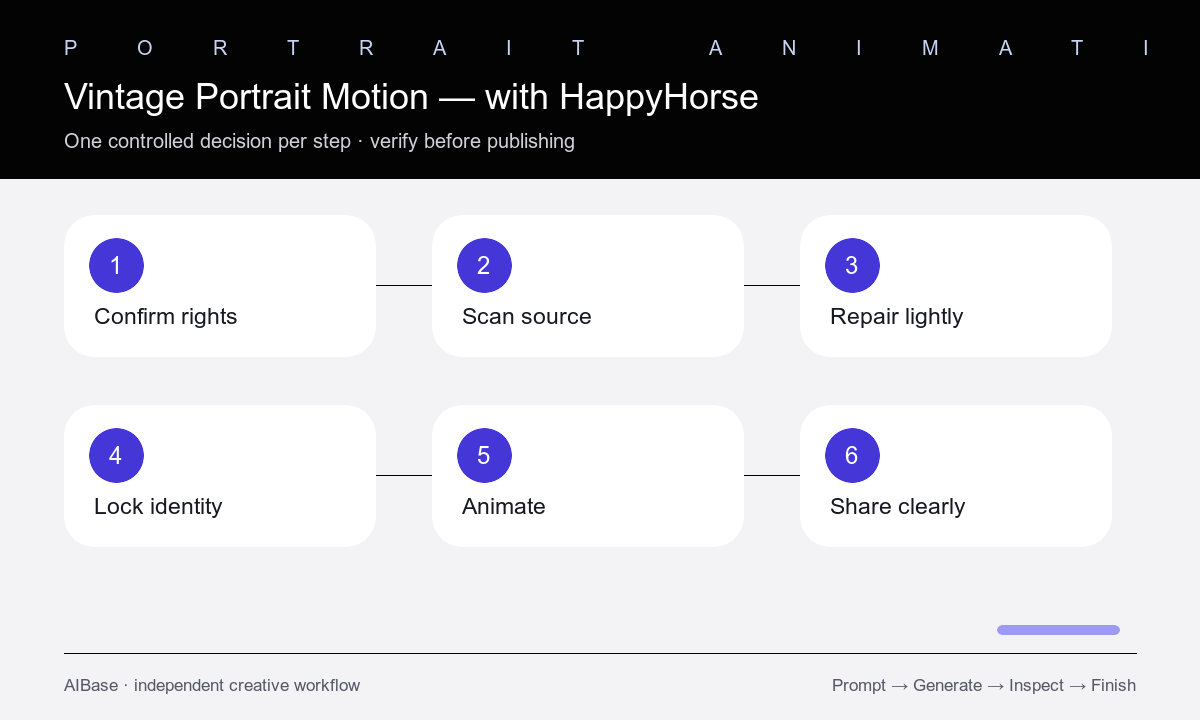
- Confirm ownership, consent where possible, cultural and family sensitivity, intended audience, disclosure, and whether animation is appropriate for the person and context.
- Scan or photograph the original at high quality, preserve an untouched master, and document the date, source, known identity, and historical details.
- Repair only distracting dust, scratches, tears, or fading before animation; avoid face reconstruction, beautification, aggressive sharpening, or unverified colorization.
- Write an identity and period lock covering age, expression, hairstyle, pose, hands, clothing, insignia, jewelry, props, backdrop, crop, tone, and grain.
- Generate one short locked-camera micro-motion with no speech, then compare the first, middle, and final frames directly to the source.
- Share with clear labeling, contextual captioning, appropriate privacy settings, and the unanimated original nearby when historical accuracy matters.
Example prompt variants
- Keep the exact elderly woman’s face, calm expression, pinned hair, lace collar, brooch, seated pose, painted backdrop, sepia tone, vignette, and grain; animate one slow natural blink and subtle breathing, camera fixed.
- Preserve the exact young soldier’s apparent age, neutral gaze, cap, uniform, buttons, insignia, shoulders, studio background, scratches, and monochrome texture; add only a tiny breath, no smile or head movement.
- Keep both exact sibling identities, ages, expressions, joined arm positions, dresses, shoes, chair, painted garden backdrop, crop, and paper texture; animate synchronized subtle breathing only, no new interaction.
Quality checklist
- Rights, consent, cultural sensitivity, audience, storage, disclosure, and historical context have been reviewed before generation or sharing.
- Identity, apparent age, expression, gaze, hair, body, pose, hands, clothing, insignia, jewelry, objects, backdrop, and crop match the source.
- Black-and-white or sepia tone, grain, softness, damage, and conservative restoration level remain historically coherent.
- Motion is short, subtle, anatomically plausible, silent, free of uncanny eyes or mouth movement, and returns to a stable pose.
- The final presentation is clearly labeled as animated, avoids fabricated biography or speech, and retains access to the original image.
Mistakes to avoid
- Animating a sensitive, private, sacred, military, memorial, or culturally significant portrait without considering permission and context.
- Combining restoration, colorization, age change, smile generation, speech, head turns, and camera motion in one request.
- Allowing uniforms, insignia, jewelry, clothing, hands, age, expression, or backdrop to drift from the historical source.
- Sharing the clip as authentic footage or implying speech, emotion, intent, or biography that the photograph cannot establish.
Related AIBase pages
- Open HappyHorse
- Read the HappyHorse image-to-video guide
- Use identity-stable portrait prompts
- Restore a photo before animation
Practical next step
Open the most relevant AIBase generator, run one narrow prompt first, and save the best result before adding more constraints. The fastest way to improve output quality is to compare one variable at a time: subject, camera, background, lighting, then final polish.