
Veo 3.1 Pro Handcrafted Shoe Brand Film Prompts
Plan cinematic shoemaking films while keeping real makers, workshops, materials, construction steps, origin, labor, durability, sustainability, and product details truthful.
Quick answer
Film real makers, workshops, lasts, tools, cutting, stitching, lasting, welting, finishing, and completed shoe SKUs whenever the brand story depends on those facts. Use Veo 3.1 Pro for abstract cinematic plates—light across unmarked leather texture, thread-like lines tightening, or a generic dust-and-shadow transition—not synthetic documentary evidence. Never fabricate artisan identity, handwork, country of origin, material, construction method, labor conditions, repairability, durability, sustainability, limited production, or heritage. Composite verified product plates and approved facts in editing.
Who this guide is for
Footwear brands, independent shoemakers, ateliers, retailers, filmmakers, and agencies producing launch films, workshop stories, product pages, trade-show loops, or social cutdowns.
Recommended model
| Use case | Recommended model | Why |
|---|---|---|
| This workflow | Veo 3.1 Pro for cinematic abstract plates around authentic shoemaking footage | Longer visual development can support a premium material story, while the people, craft process, product construction, origin, labor, and performance claims must come from documented reality. |
AIBase is an independent creative platform. Model names are shown only to identify supported underlying technologies and workflow choices.
Prompt template
Create one [5-8 second] clearly illustrative cinematic plate for a handcrafted footwear brand film. Story job: [material prologue / transition between real process stages / product-reveal atmosphere / end-card texture]. Abstract subject: [light tracing an unmarked leather grain / dark thread-like fibers drawing taut over a neutral surface / fine polishing dust settling through side light]. Camera: [one controlled move], lens feel [specific], light [specific], palette [specific], stable edit handles. No maker, hand, workshop, shoe, last, tool, cutting, stitching, welt, sole, logo, country, heritage cue, certification, animal-origin cue, sustainability symbol, durability test, word, sound, or watermark.
Step-by-step workflow
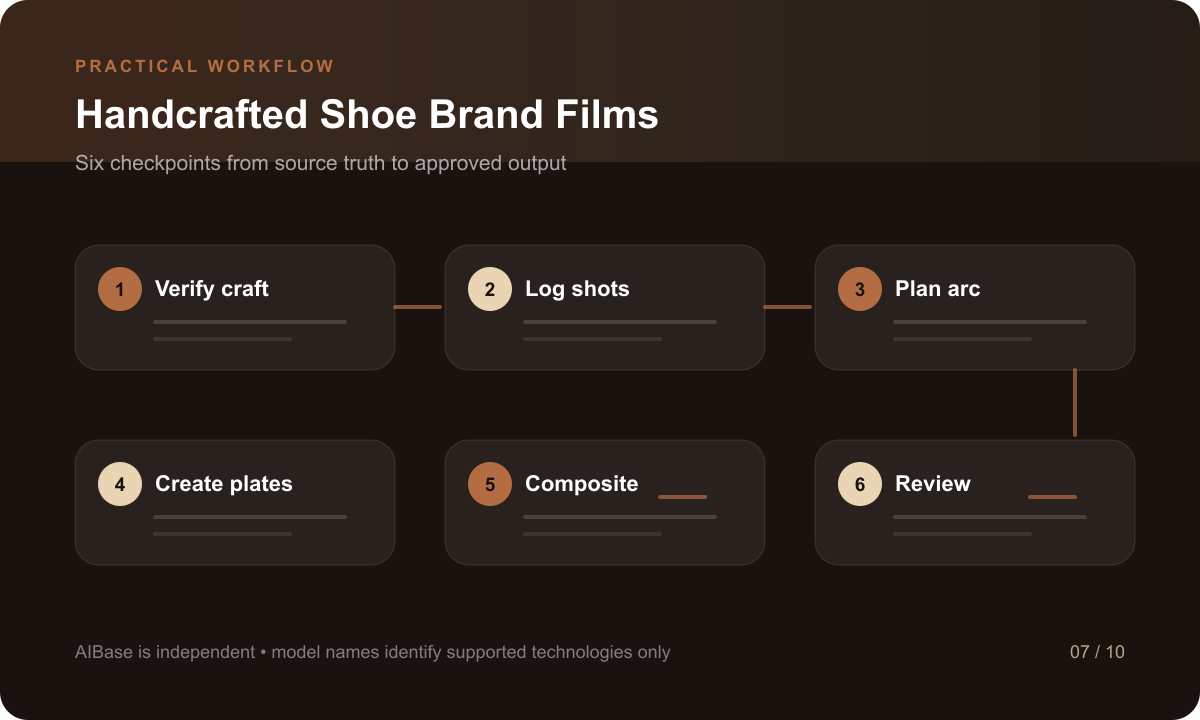
- Freeze the actual maker identities, workshop locations, product SKUs, materials, suppliers, construction methods, process order, labor claims, origin rules, repair policy, certifications, and usage rights.
- Build a shot ledger classifying authentic documentary footage, approved product plates, licensed context, and clearly illustrative generated transitions; identify the factual claim attached to each real shot.
- Storyboard a restrained arc from material to making to finished product, reserving generated plates only for non-factual mood, chapter transitions, and copy-safe end frames.
- Generate one abstract plate at a time with a single camera move, stable edit handles, and no synthetic craft process, person, workshop, product, heritage, origin, or performance evidence.
- Composite real maker and process footage, exact shoe SKU, approved macro details, verified captions, origin and material language, disclosure, licensed sound, and CTA.
- Review product construction, process sequence, maker attribution, labor, material, heritage, sustainability, durability, repair, localization, accessibility, and every cutdown before publication.
Example prompt variants
- Seven-second material prologue: warm side light travels slowly across an unmarked full-grain texture, macro shallow depth, chestnut and black palette, no hide outline, animal cue, tool, hand, shoe, logo or text.
- Five-second chapter transition: three dark thread-like fibers draw gently taut over a neutral work surface as dust settles, locked overhead camera, no stitching claim, needle, welt, maker, word or sound.
- Eight-second end-card atmosphere: a narrow amber beam reveals layered abstract sole-like materials without forming a shoe, slow lateral move, clean center title zone, no product, performance test, origin badge or logo.
Quality checklist
- Makers, workshops, SKUs, materials, suppliers, construction, sequence, origin, labor, heritage, repair, certifications, performance claims, and rights are verified.
- Every real process shot shows the correct product stage, tool, technique, safety context, maker attribution, and relationship to the finished SKU.
- Generated plates contain no synthetic maker, hand, workshop, process, shoe, logo, origin, heritage, certification, sustainability, durability, or performance evidence.
- Product plates, captions, claims, disclosure, subtitles, audio rights, color, pacing, CTA, accessibility, localization, and cutdowns pass stakeholder review.
- Fact sheet, shot ledger, releases, prompts, outputs, edit versions, craft approval, corrections, and publication scope remain traceable.
Mistakes to avoid
- Generating beautiful workshop footage and presenting fictional tools, techniques, makers, locations, or construction stages as documentary truth.
- Using leather, hand-stitching, welt, handmade, heritage, local, ethical, sustainable, repairable, or durable language without SKU-specific evidence.
- Letting an abstract plate accidentally form a different sole, stitch pattern, material, logo, hardware detail, or shoe silhouette than the real product.
- Building the entire film from mood shots while omitting real makers, verified process, product detail, disclosure, captions, claims review, and source records.
Related AIBase pages
Practical next step
Open the most relevant AIBase generator, run one narrow prompt first, and save the best result before adding more constraints. The fastest way to improve output quality is to compare one variable at a time: subject, camera, background, lighting, then final polish.