
Wan 2.7 Fabric Motion Product Video Prompts for Apparel and Textiles
Animate apparel and textile references with Wan 2.7 prompts that preserve construction, control wind or drape, keep fabric physics plausible, and protect product truth.
Quick answer
Start with an authorized apparel or textile image that clearly shows construction and surface. Protect silhouette, seams, weave, print placement, closures, and styling, then request one low-amplitude fabric behavior such as a light breeze, small drape settling, or controlled fold. Reject clips that stretch the garment, change the pattern, or invent movement the real material would not make.
Who this guide is for
Fashion ecommerce teams, textile studios, apparel brands, home-goods sellers, social editors, and agencies creating short motion studies for garments, scarves, curtains, bedding, upholstery, and material swatches.
Recommended model
| Use case | Recommended model | Why |
|---|---|---|
| This workflow | Wan 2.7 image-to-video | A reference-led image-to-video workflow can preserve the approved composition while adding a bounded fabric motion for product pages, social posts, mood films, and editorial transitions. |
AIBase is an independent creative platform. Model names are shown only to identify supported underlying technologies and workflow choices.
Prompt template
Use the uploaded authorized [garment/textile] image as the exact first-frame reference. Preserve silhouette, dimensions, cut, seams, hems, pleats, weave, print registration, colors, closures, hardware, styling, support, background, crop, and lighting. MATERIAL: [fiber, weight, stiffness, sheen]. Animate only [gentle breeze/drape settling/one fold release] with low amplitude from [direction] for [duration]. Camera: [locked or one slow move]. Return to a stable natural pose. No body change, garment redesign, stretch, extra fold, changing print, duplicated edge, clipping, floating fabric, impossible wind, text, or watermark.
Step-by-step workflow
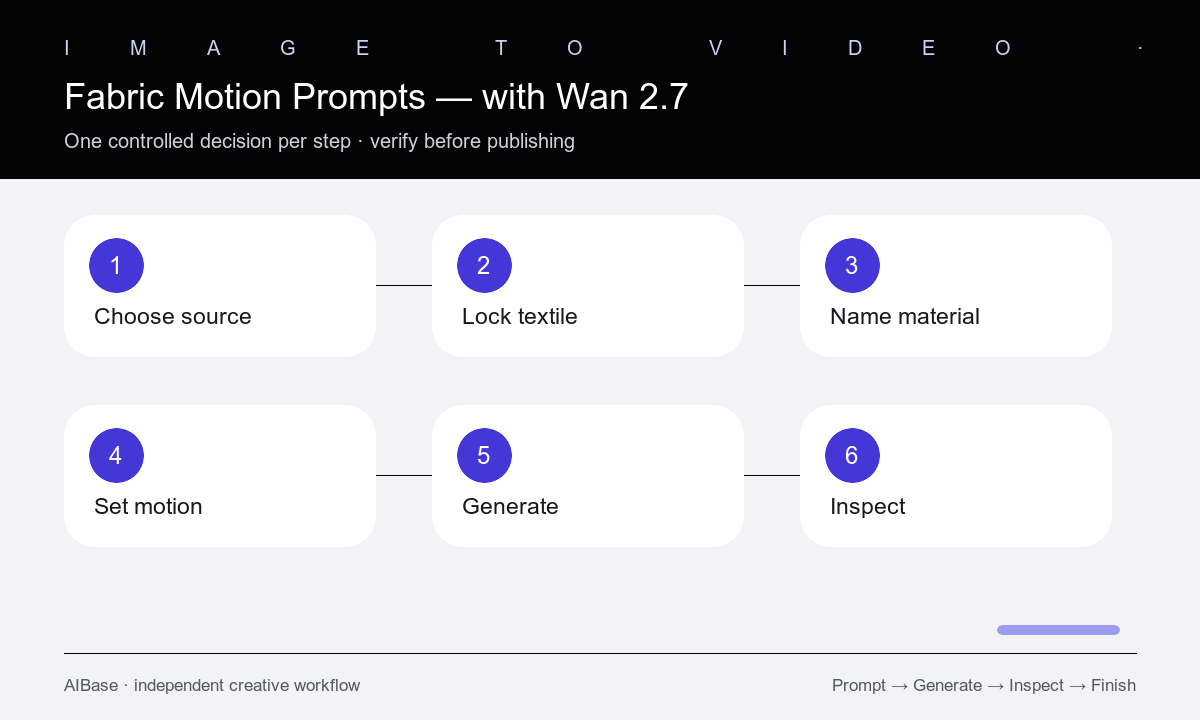
- Choose a sharp authorized source that shows the full moving region, garment support, edges, construction, print, and surrounding space.
- Write a textile lock covering cut, seams, hems, pleats, pattern registration, color, closures, hardware, mannequin or body, styling, and camera.
- Describe material behavior with real properties such as lightweight silk, crisp cotton poplin, heavy wool, soft linen, or structured upholstery.
- Request one low-amplitude force and one response: breeze direction, gravity settling, fold release, edge flutter, or curtain sway.
- Generate with a locked camera first, then add only a minimal push or slide after fabric behavior and product details remain stable.
- Inspect edges, seams, pattern alignment, body contact, occlusion, fold continuity, gravity, wind direction, reflections, and ending pose frame by frame.
Example prompt variants
- Keep the exact silk scarf print, border, knots, colors, table, and light; one corner lifts gently in a light breeze from left and settles, camera fixed, no pattern warping.
- Preserve the exact linen dress cut, neckline, sleeves, seams, waist, hem, model pose, and background; fabric breathes subtly with one soft forward breeze, body and camera locked.
- Keep the exact heavy wool throw size, fringe count, weave, color blocks, sofa, and crop; one folded edge relaxes naturally under gravity, slow close push, no wind or new crease.
Quality checklist
- Silhouette, cut, construction, seams, hems, pleats, pattern placement, colors, closures, and styling remain faithful.
- The motion matches the stated fiber, weight, stiffness, sheen, support, gravity, and force direction.
- Fabric edges, folds, prints, fringes, hands, body contact, mannequin, furniture, and background do not clip, duplicate, or drift.
- The camera stays within the planned move and the clip provides a clean start, plausible motion arc, and stable end frame.
- The final presentation does not imply an unverified fabric composition, fit, stretch, drape, durability, included item, or color.
Mistakes to avoid
- Using generic flow dramatically language without defining material weight, force, direction, and amplitude.
- Requesting walking, spinning, camera orbit, strong wind, and a garment reveal in one short clip.
- Ignoring pattern registration, seam positions, fringe count, closure details, or body contact because the motion looks elegant.
- Presenting generated drape, fit, stretch, or fabric response as evidence of the real product without verification.
Related AIBase pages
- Open Wan 2.7
- Follow the Wan 2.7 image-to-video workflow
- Create fashion product video prompts
- Build vertical social video prompts
Practical next step
Open the most relevant AIBase generator, run one narrow prompt first, and save the best result before adding more constraints. The fastest way to improve output quality is to compare one variable at a time: subject, camera, background, lighting, then final polish.