
Veo 3.1 Pro Sustainable Fashion Brand Film Prompts with Claim Controls
Plan cinematic sustainable-fashion brand-film shots with Veo 3.1 Pro while keeping sourcing, labor, material, certification, impact, and product claims verifiable.
Quick answer
Separate brand atmosphere from sustainability evidence. Veo 3.1 Pro can explore cinematic fabric, landscape, studio, and movement plates, but generated farms, factories, workers, fibers, recycling processes, certifications, or impact outcomes are not proof. Use authorized documentary footage and verified data for sourcing and labor claims; keep synthetic shots text-free, bounded, and clearly disclosed when viewers could mistake them for real operations.
Who this guide is for
Fashion brands, creative directors, agencies, sustainability teams, and ecommerce marketers producing a manifesto film, collection launch, trade presentation, retail screen loop, or cinematic social cutdown.
Recommended model
| Use case | Recommended model | Why |
|---|---|---|
| This workflow | Veo 3.1 Pro for selected cinematic atmosphere plates, with verified capture for products, people, facilities, and sustainability evidence | A quality-focused video workflow suits deliberate material and camera studies, while strict source routing prevents cinematic generation from fabricating supply-chain or environmental proof. |
AIBase is an independent creative platform. Model names are shown only to identify supported underlying technologies and workflow choices.
Prompt template
Create a cinematic [4-8 second] text-free atmosphere plate for an approved sustainable-fashion brand film. Purpose: [material mood / transition / abstract theme], not documentary evidence. Subject: [generic fabric form or non-identifiable environment]. One motion event: [specific]. Camera: [one movement], lens and framing: [specific], light and palette: [specific], stable final frame and crop-safe center. Do not depict or imply a real farm, fiber origin, factory, worker, artisan, wage condition, certification, recycling process, chemical safety, water or carbon reduction, waste diversion, circularity result, product performance, exact garment, brand logo, care label, traceability code, statistic, claim, or text. Return a clearly illustrative plate for controlled editing and disclosure.
Step-by-step workflow
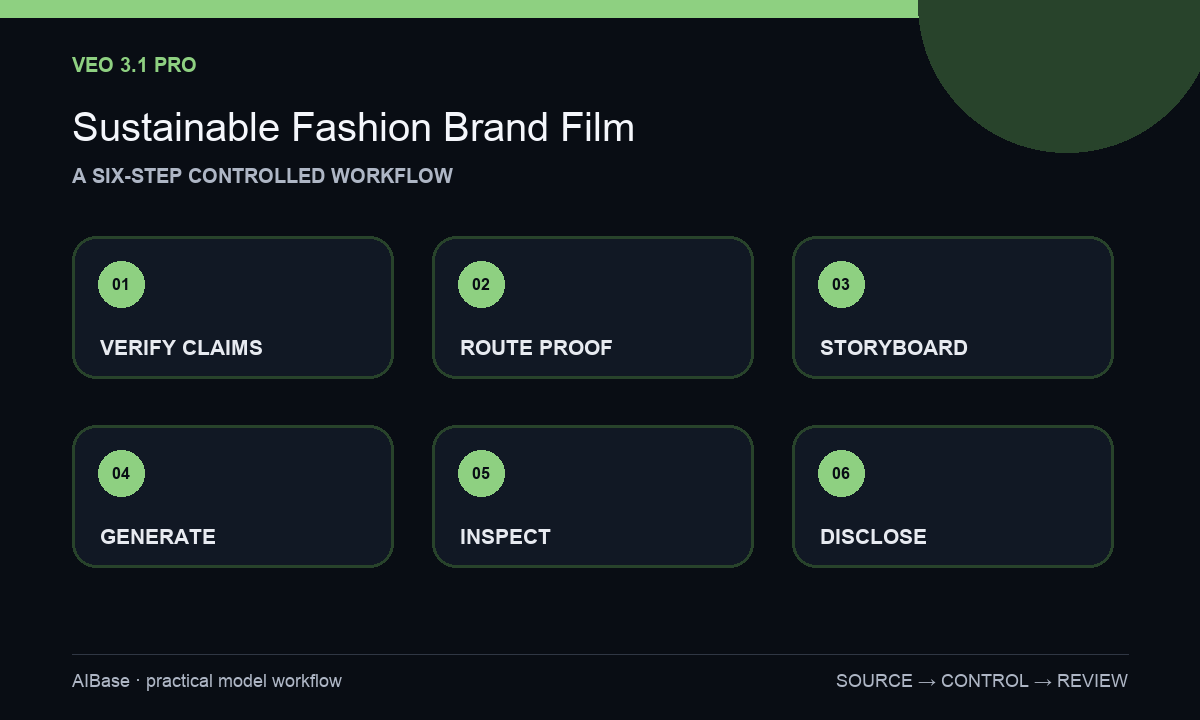
- Build a claim register for fibers, percentages, certifications, supplier locations, labor standards, traceability, emissions, water, chemicals, packaging, durability, repair, take-back, and circularity, with evidence, scope, owner, and expiry.
- Classify each storyboard beat as verified documentary evidence, exact product or label capture, licensed contextual footage, controlled data graphic, customer instruction, or synthetic atmosphere.
- Write a visual grammar for camera pace, fabric movement, palette, sound, copy zones, and transitions, then limit synthetic shots to motifs that do not resemble supply-chain evidence.
- Generate one motion event per plate, select only shots with stable material behavior and no accidental label, worker, facility, process, geography, wildlife, or environmental-result implication.
- Composite exact garments, logos, certifications, percentages, maps, suppliers, dates, qualifiers, citations, and legal copy from approved sources; use real capture wherever a viewer expects proof.
- Run sustainability, legal, product, supplier, labor, brand, accessibility, localization, disclosure, and destination review; archive the claim version and retire the film when evidence changes.
Example prompt variants
- Six-second abstract textile atmosphere plate, an unbranded undyed fabric ribbon makes one slow arc through soft side light in a neutral studio, macro-to-medium dolly, no garment, fiber claim, worker, factory, landscape, label, certification, leaf symbol, or text.
- Five-second coastal color-and-motion transition using only wind across pale grasses and a blank cloth panel in the foreground, locked horizon and slow lateral camera, no farm, conservation claim, carbon implication, garment, person, logo, or wording.
- Seven-second dark studio material study, three generic woven swatches remain fixed while one controlled light band travels across their textures, no claim that materials are recycled, organic, low-impact, traceable, certified, or used in a specific product.
Quality checklist
- Every sustainability, material, labor, supplier, certification, impact, durability, repair, take-back, and circularity statement maps to current scoped evidence.
- Synthetic footage cannot be mistaken for a real supplier, worker, facility, fiber source, recycling process, garment, or measured environmental result.
- Exact products, labels, certificates, percentages, dates, maps, qualifiers, sources, logos, and legal lines remain approved controlled assets.
- Fabric and camera motion are coherent, crops are safe, captions and audio are accessible, and disclosures remain legible in every cutdown.
- Claim register, sources, storyboard routing, prompts, outputs, composites, reviewers, exports, destinations, and retirement rules remain traceable.
Mistakes to avoid
- Generating a beautiful factory, farm, artisan, recycling line, or natural landscape and presenting it as the brand’s real supply chain.
- Using vague green imagery—leaves, water, earth tones, clean air—to imply broad environmental benefit without a precise supported claim.
- Showing a generated garment or care label whose fiber content, construction, colorway, certification, or traceability differs from the product.
- Treating a permanent campaign film as timeless when certification scope, supplier status, percentage, methodology, product range, or regulation can change.
Related AIBase pages
- Open Veo 3.1 Pro
- Create cinematic fashion films
- Create outdoor apparel brand films
- Create apparel campaign product photos
Practical next step
Open the most relevant AIBase generator, run one narrow prompt first, and save the best result before adding more constraints. The fastest way to improve output quality is to compare one variable at a time: subject, camera, background, lighting, then final polish.