
Wan 2.7 Water Splash Product Video Prompts with Stable Packaging
Animate a water splash around a product with Wan 2.7 while preserving packaging, controlling fluid direction, volume, contact, camera, and a clean final frame.
Quick answer
Keep the product locked and choreograph the water as a separate subject. Specify the splash origin, direction, volume, arc, droplet size, speed, product contact, gravity, camera behavior, and resting end state; use a modest effect first, then reject any clip where water passes through the pack or changes labels, closures, materials, or product count.
Who this guide is for
Beverage, skincare, outdoor, cleaning, and ecommerce creative teams prototyping short freshness or water-context shots from an approved product image without claiming unverified waterproofing or performance.
Recommended model
| Use case | Recommended model | Why |
|---|---|---|
| This workflow | Wan 2.7 in image-to-video mode | The reference-led workflow and short adjustable-format output suit restrained product motion tests where the still image defines packaging and the prompt defines one fluid event. |
AIBase is an independent creative platform. Model names are shown only to identify supported underlying technologies and workflow choices.
Prompt template
Use the uploaded approved product image as the exact anchor. Keep the product silhouette, proportions, count, cap or closure, material, color, label zones, base contact, position, surface, lighting, shadows, reflections, and crop unchanged. Animate only one water event: [origin], [direction], [small/medium volume], [arc or sheet], [droplet scale], [speed], making [limited contact/no contact] and falling naturally under gravity before [clean end state]. Camera [locked/one slow move], [duration], [ratio]. No product rotation, deformation, label drift, open cap, liquid passing through packaging, impossible suspended water, flood, duplicate product, waterproof claim, text, or watermark.
Step-by-step workflow
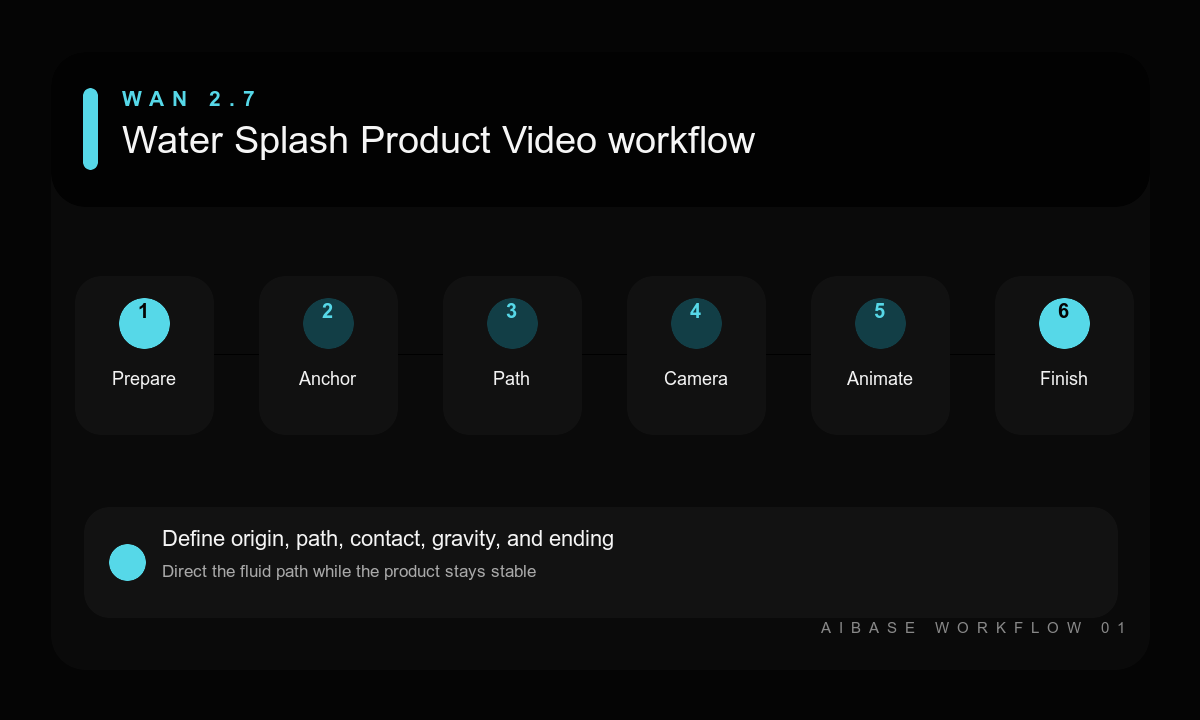
- Confirm the creative intent and remove any waterproof, freshness, purity, or durability implication that is not substantiated.
- Prepare a sharp product reference with visible edges, closure, label zones, contact shadow, and enough room for the fluid path.
- Write product anchors first, then diagram one splash origin, path, contact point, gravity direction, and end state.
- Use a locked camera for the first pass and keep fluid volume modest before testing a larger motion.
- Review at reduced speed for packaging drift, intersections, broken droplets, reflection errors, and an unusable final frame.
- Add verified copy and sound in post, then route the composite through product, brand, claims, and channel review.
Example prompt variants
- Keep the exact clear sparkling-water can, silver top, blue label zone, upright position, stone base, and backlight; one small arc of water passes behind the can from left to right, a few droplets land on the surface, locked camera, six seconds.
- Keep the exact white sunscreen tube, orange cap, print zones, sand pedestal, and warm light; one low sheet of water moves across the foreground without touching or moving the tube, vertical crop, clean two-second ending.
- Keep the exact green shampoo bottle, black pump, label zone, wet tile, reflection, and crop; one medium splash rises behind the bottle and falls naturally, no pump motion or water through the pack, square locked shot.
Quality checklist
- Product geometry, closure, materials, colors, label zones, count, position, and base contact stay unchanged.
- Water origin, direction, volume, arc, droplet scale, speed, gravity, contact, and reflections are coherent.
- No liquid intersects solid packaging, freezes unnaturally, duplicates, or hides critical product details.
- The camera and background remain stable and the last frames provide a useful edit point.
- The concept does not imply unsupported waterproofing, purity, freshness, or product performance.
Mistakes to avoid
- Asking for an epic water explosion without defining its path, scale, contact, or ending.
- Moving the product, camera, background, and splash simultaneously in the first test.
- Ignoring label mutation and package intersections because the fluid draws attention.
- Using water imagery to imply a product property that has not been verified.
Related AIBase pages
- Animate a product with Wan 2.7
- Follow the Wan 2.7 image-to-video workflow
- Create a Wan 2.7 product rotation
- Build loop-friendly video prompts
Practical next step
Open the most relevant AIBase generator, run one narrow prompt first, and save the best result before adding more constraints. The fastest way to improve output quality is to compare one variable at a time: subject, camera, background, lighting, then final polish.